Robots build almost everything around us — your car, your fridge, your phone. There are already over 4 million industrial robots humming away in factories worldwide, and the International Federation of Robotics reckons that figure could top 16 million by 2030. But here’s the question nobody likes asking: what happens when all those machines break?
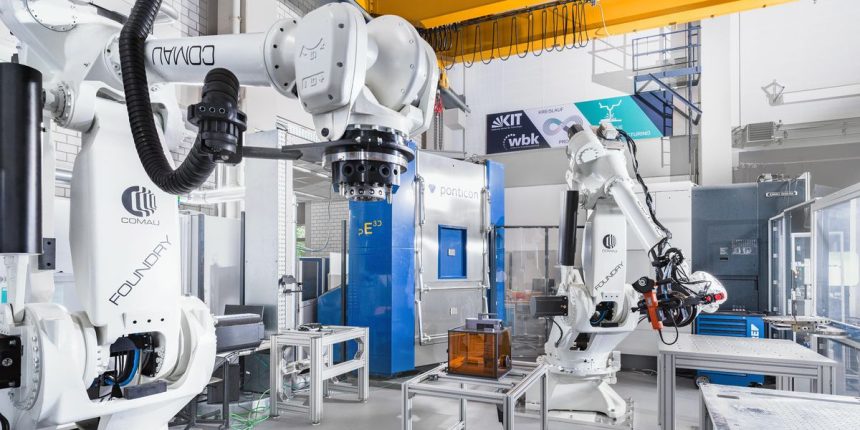
Researchers at the Karlsruhe Institute of Technology (KIT) in Germany have built a system that tackles exactly that. It predicts how a robot has failed, then carefully takes it apart — all while protecting the valuable components inside from damage. The work was presented at the IEEE International Conference on Robotics and Automation (ICRA) 2026 in Vienna.
The clever part is that disassembly is far messier than assembly. Building something new is predictable: every step is laid out, nothing deviates. Pulling apart a broken device is chaos. “We can imagine 100 ways that something can go wrong,” says Jan Baumgärtner, one of the system’s designers. Unscrew 100 bolts holding two parts together, hit a seized screw on the last one, and you’ve wasted all that effort when a different method would have worked from the start.
To avoid that, the KIT system leans on two things: a CAD model of the robot and each of its parts, plus a mathematical model that predicts damage. It works like a detective. When a part is nudged, the system watches how it actually moves along its expected axes — its degrees of freedom. A screw should rotate but not slide sideways. If a part moves less than expected, it might be corroded; more than expected, a screw is probably loose; if it moves in unexpected ways, it’s likely deformed.
From those observations, the system builds a plan on the fly and constantly checks reality against its own predictions. In one demonstration, it began unscrewing a component. A researcher swapped in a fixed screw to fake a seized fastener. Seeing the screw stubbornly refuse to move, the system simply switched tactics — milling away the surrounding material to free the part instead.
You can also tell it which components matter most, and it will adjust its strategy to salvage those intact.
Baumgärtner’s endgame is bigger than one clever robot. He wants to fuel a genuine circular economy, where old devices are broken down to build new ones. He imagines scaling the current handful of robotic arms into something like “a giant robot with 100 arms,” each specialised with different tools — an entire factory dedicated to taking things apart rather than putting them together.
The real prize is economics. “It becomes so cheap that it’s cheaper to repair this than to produce it,” he says. “That’s the goal.” Get there, and replacing a broken part could finally beat buying yet another gadget — a rare win for both wallets and the planet.