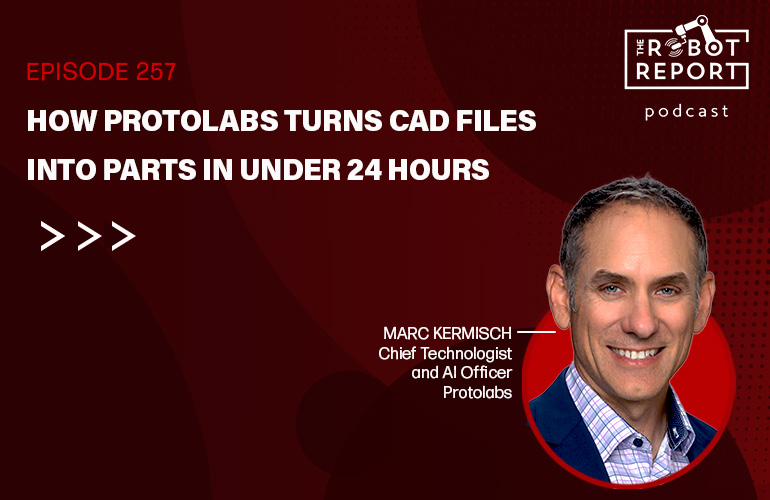
Uploading a 3D model and holding the physical part the next morning sounds like a fantasy for anyone who has waited weeks on a traditional machine shop. Protolabs, the digital manufacturing service, has built its entire business around collapsing that timeline — and CTO Marc Kermisch recently pulled back the curtain on how it actually works.
The premise is deceptively simple. A designer or engineer picks a manufacturing process, uploads a CAD file, and within a few hours receives a design-for-manufacturability analysis alongside real-time pricing. No back-and-forth quoting, no phone calls, no waiting on a human estimator to eyeball your geometry. Approve the job and parts can arrive in as fast as one day.
What makes that speed possible isn’t a single trick but a stack of them. Protolabs runs several manufacturing technologies under one roof:
- 3D printing for rapid prototypes and complex geometries
- CNC machining for tight-tolerance metal and plastic parts
- Sheet metal fabrication for enclosures and brackets
- Injection molding for higher-volume production runs
The clever part happens the moment your file lands. Instead of a person interpreting the design, software analyzes the geometry, flags features that will cause trouble — walls too thin, undercuts a tool can’t reach, radii that fight the process — and prices the job automatically. Kermisch frames this as the intersection of AI, simulation, and design for manufacturing: the same discipline a seasoned toolmaker applies by instinct, encoded so it can run in minutes rather than days.
That matters because most of the pain in getting a part made isn’t the machining itself. It’s the iteration. A design that looks flawless on screen can be impossible, or absurdly expensive, to actually manufacture. By surfacing those issues before a single chip is cut, the platform lets engineers fix problems while the CAD is still open, not after a failed first article comes back a week later.
Simulation adds another layer, letting the system predict how a part will behave in a given process so the output matches the intent. Combine automated DFM feedback with real-time pricing and a network of manufacturing capacity, and you get a workflow that treats physical parts almost like a cloud service — request, configure, receive.
It’s a decidedly B2B story rather than a shiny gadget, but it’s one that ripples outward to every consumer product that starts life as a prototype. Faster iteration means hardware startups can test more ideas, kill the bad ones sooner, and reach production with fewer expensive surprises. When the gadget on your desk went through half a dozen physical revisions before launch, tools like this are a big reason its makers could afford to.
The takeaway from Kermisch is that manufacturing is quietly becoming a software problem — and the companies that treat it that way are the ones shipping parts while everyone else is still waiting on a quote.