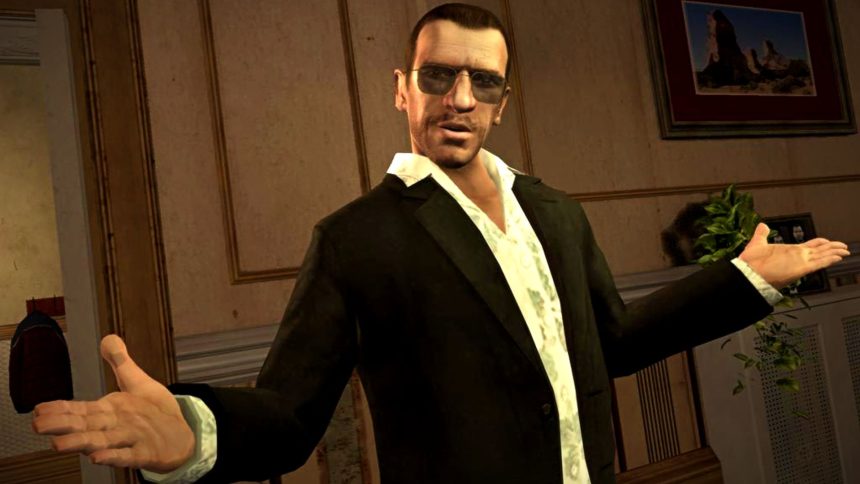
Ever wondered why the pedestrians in an open-world game feel a little like cardboard cutouts wandering the same three blocks forever? According to a former Rockstar insider, it’s not laziness — it’s a deliberate design call, and one that saved GTA 4 from drowning in its own ambition.
Former Rockstar technical lead Obbe Vermeij, who has become one of the most candid voices on the studio’s past, told Edge Magazine that producer Leslie Benzies originally wanted every last civilian in Grand Theft Auto IV to lead a genuinely simulated life. Not just idle animations and canned barks, but actual routines.
“Leslie Benzies wanted all the [GTA 4] NPCs to have their own lives,” Vermeij recalled. “A place to live. A schedule. Every morning, they would drive to work. We worked towards it for a bit, but it ended up being so problematic.”
The timing didn’t help. GTA 4 was Rockstar’s leap onto the PS3 and Xbox 360, and even that then-cutting-edge hardware buckled under the idea of an entire city where every resident had somewhere to be. Fully simulating thousands of digital citizens meant tracking homes, jobs and commutes, and the result was predictably messy.
“There were so many bugs,” Vermeij said. But the deeper problem, in his view, wasn’t technical at all — it was that the payoff simply wasn’t there.
“I didn’t like the idea [of fully simulated NPCs] because it felt like it didn’t really matter that much,” he explained. “It wasn’t really important that everyone had their own schedule and their own life.”
His takeaway cuts against the grain of the “more realism is always better” mantra that dominates blockbuster development. Vermeij argues players are perfectly content with a bit of artifice:
- “I actually think that, psychologically, players are fine with NPCs being a little fake and shallow.”
- “What it comes down to is that realism is just not necessarily something to aim for in a game.”
It’s a refreshingly honest admission, and it reframes how we should read the crowds in these worlds. The illusion of a living city is often more effective — and far cheaper on the CPU — than the real thing. A pedestrian who exists only within your camera’s view will never bump into a scheduling bug, get stuck in a doorway, or vanish because the simulation choked.
Grand Theft Auto has always thrived as a chaotic sandbox rather than a meticulous city simulator, and Benzies’ abandoned vision is a neat reminder that sometimes the smartest engineering decision is knowing what not to build. Whether Rockstar’s next entry chases that elusive full simulation or keeps leaning on smoke and mirrors is a question for the future — but if Vermeij is right, the mirrors were doing just fine all along.