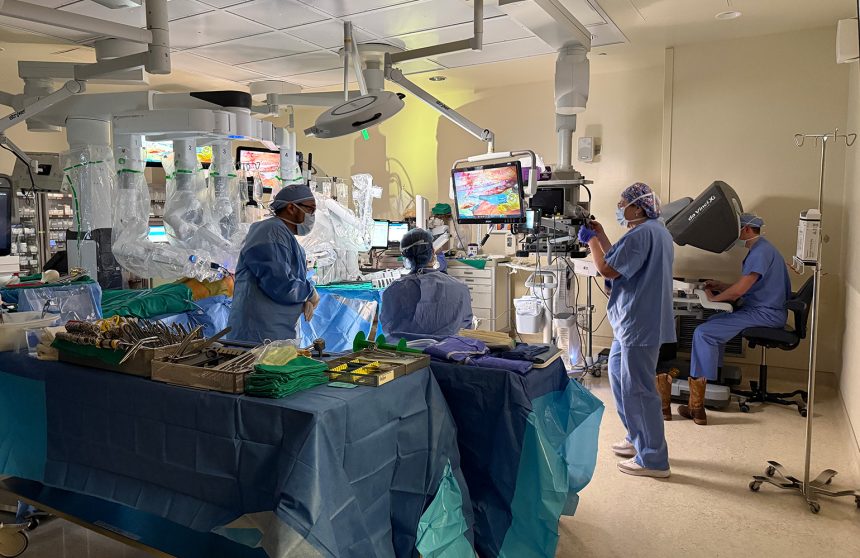
Surgeons at the El Camino Health Heart and Vascular Institute have started performing cardiac procedures with Intuitive’s da Vinci 5, marking one of the early real-world deployments of the system for heart surgery in the United States.
This is a meaningful shift. The da Vinci platform has long dominated minimally invasive general surgery, but cardiac work is a different beast — the target is moving, the margins are tiny, and the stakes are absolute. The FDA cleared the da Vinci 5 system for certain cardiac procedures on January 26, 2026, and a limited number of U.S. sites are working with Intuitive through 2026 to establish da Vinci 5 cardiac programs. El Camino is among the first to put that clearance into practice.
What makes the fifth-generation system suited to this task is a genuine leap in hardware and processing. Intuitive packed in more than 150 enhancements over the previous model, including improved accuracy, a next-generation 3D display and image processing pipeline, and first-of-its-kind force-sensing technology. The system carries over 10,000 times the computing power of its predecessor, the da Vinci Xi — a figure that reads less like an upgrade and more like a generational rebuild.
The headline feature for delicate cardiac tissue is force feedback. The da Vinci 5 ships with six Force Feedback-enabled instruments covering dissection, retraction, and suturing, with a sensing range optimized for 0–6.5 N. Sensors in the instruments measure directional forces and refresh in real time at roughly 1,000 samples per second, giving the surgeon a tactile sense of how hard they are pushing and pulling — something earlier robotic systems simply could not convey.
Why does that matter? On the heart, excessive force translates directly into tissue trauma. Being able to feel resistance, rather than infer it from a video feed, lets surgeons handle vessels and sutures with a lighter, more informed touch. It is the closest robotic surgery has come to replicating the surgeon’s own hands.
- Model: da Vinci 5 by Intuitive Surgical
- Cardiac clearance: FDA-cleared for certain cardiac procedures on January 26, 2026
- Force sensing: six instruments, 0–6.5 N range, ~1,000 samples per second
- Computing: over 10,000 times the power of the da Vinci Xi
None of this comes cheap. A da Vinci 5 system runs between US$1.8 to US$2.5 million, a price that reflects both the engineering and the fact that these platforms anchor an entire surgical program rather than sit in a single operating room. The original da Vinci 5 received FDA approval back on March 14, 2024; the cardiac clearance is a later, more specialized milestone.
For patients, the promise is familiar territory taken further — smaller incisions, less trauma, faster recovery — now extended to procedures where the surgeon’s touch has always been the deciding factor. El Camino’s early adoption suggests robotic cardiac surgery is moving from novelty to routine.