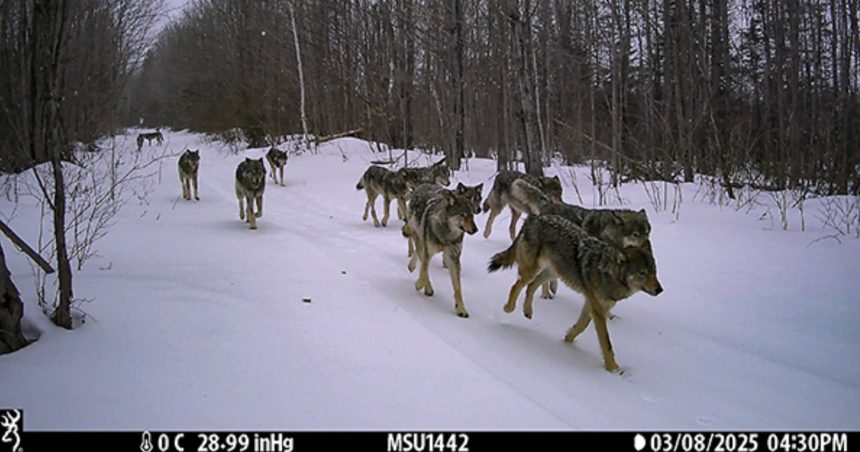
Counting wolves is notoriously tricky. They’re elusive, they roam huge territories, and for decades Michigan relied on winter track surveys — following paw prints across fresh snow. That method works, but it only ever delivers a minimum headcount, and only when there’s snow on the ground. Now researchers from Michigan State University and the Michigan Department of Natural Resources (DNR) have cracked a year-round approach using nothing more exotic than remote cameras.
The scale is what makes this impressive. The team deployed 1,311 DNR-owned cameras across the Upper Peninsula, mounting them on tree trunks roughly four to five feet high along low-use roads and trails where wolves were likely to pass. Each rig ran for a full year between servicing — the crew swapped memory cards and batteries annually. To keep things transparent, they even posted notices explaining the cameras’ research purpose to anyone who wandered by.
All told, the network captured more than two million images, and not just of wolves. White-tailed deer, coyotes, wild turkeys, red foxes, black bears and bobcats all wandered into frame. Sorting that mountain of photos by hand would be impossible, so the researchers leaned on machine-learning software to identify the animal in each shot, then manually reviewed the results to confirm accuracy. The software also automatically stripped out any images showing people or vehicles — a neat privacy safeguard built into the pipeline.
The real cleverness lies in the math. Using a scientific space-to-event model, the team could translate raw sightings into a population estimate for any given month. That’s a genuine first for Michigan: instead of a single winter snapshot, they can now watch numbers rise and fall through the year as pups are born in spring and some wolves die off in winter.
The results tracked exactly what wolf ecology predicts:
- A low of 525 wolves in March 2025
- A high of 1,198 wolves in October 2024
- Just under 800 wolves in February and March 2024 — closely matching the long-running winter track survey
“There were no real surprises,” said Matt Nelson, a Michigan State University doctoral candidate. “The camera survey worked really well and aligned with what we know about wolf ecology.”
DNR research specialist Tyler Petroelje frames the two methods as complementary rather than rivals: the track survey nails a minimum winter count, while the cameras chart total abundance across all seasons. The pilot began back in 2022 and has since expanded.
Perhaps the most compelling takeaway is versatility. As project researcher Jerrold Belant of Michigan State University put it, a single camera network can monitor many species at once — a real win for both time and cost. The DNR is already turning the same tool on the elusive gray fox. Gray wolves once ranged across all of Michigan but now live only in the Upper Peninsula, making reliable, year-round data more valuable than ever.