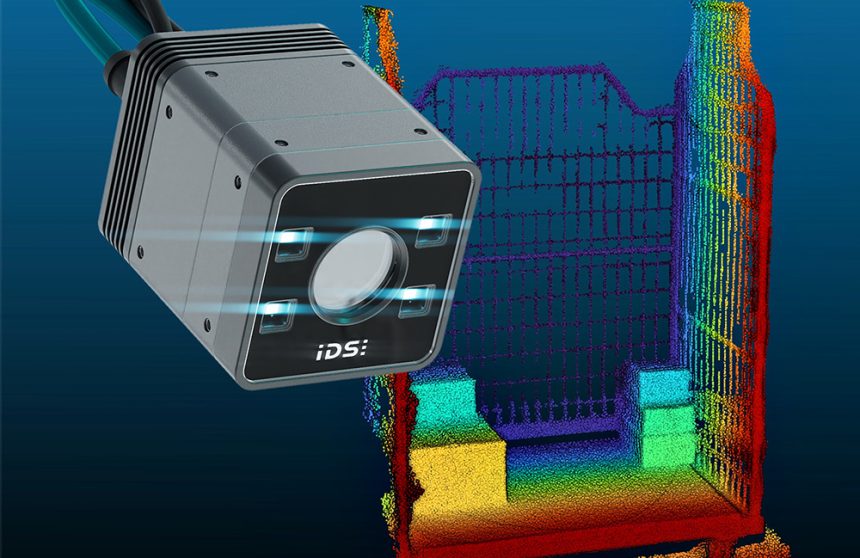
Machine vision has always faced a tension between accuracy and speed. Grab crisp 3D data and your throughput crawls; run at full tilt and your depth map turns to mush. IDS Imaging’s new Nion time-of-flight camera is built to sidestep that trade-off, delivering usable depth information at the pace real logistics and robotics lines actually run.
Announced on April 9, 2026, the Nion has since moved into series production and is now available to buy. At its heart sits onsemi’s AF0130 sensor from the Hyperlux ID family, paired with integrated depth processing so the heavy lifting happens on-camera rather than downstream.
The numbers tell a practical story:
- Resolution: 1.2 megapixels with integrated depth processing
- Sensor: onsemi AF0130 (Hyperlux ID family)
- Frame rate: 30 fps
- Measuring range: 0.3 to 7.5 metres
- Technology: indirect time-of-flight
- Housing: IP67-rated
- Power: Power over Ethernet (PoE)
Indirect time-of-flight works by measuring the phase shift of modulated light bounced off a scene, then translating that into distance for every pixel. Because the AF0130 handles depth processing internally, the Nion outputs ready-to-use 3D data at 30 fps without bogging down a host PC — exactly what you want when boxes are streaming past on a conveyor or a robot arm needs to size up a bin in real time.
The 0.3 to 7.5 metre window is a smart span for warehouse work. Close enough to profile a pallet or guide a gripper, far enough to survey a whole loading zone from a single vantage point. And the 1.2-megapixel resolution strikes a sensible balance: detailed enough to distinguish parcels and parts, coarse enough to keep the data manageable at speed.
Durability was clearly a design priority. The IP67 rating means the housing shrugs off dust and can survive temporary immersion — reassuring for a device destined to live among forklifts, dust and the occasional splash rather than in a clean lab. Power over Ethernet is the other quiet win here: a single cable carries both data and power, which cuts installation clutter and makes it far easier to bolt the Nion onto existing infrastructure or a moving platform.
The pitch from IDS is straightforward — precise 3D data at real-world process speeds — and the Nion’s spec sheet reads like it was written to that brief. For logistics operators automating depalletising, dimensioning or bin-picking, a compact, ruggedised camera that does its own depth crunching over a single PoE line is an easy addition to the toolbox.
The Nion is priced at US$1,694.53, positioning it as a serious industrial tool rather than a hobbyist gadget. Given that it slots into IDS Imaging’s existing 3D camera lineup, expect it to appeal to integrators already invested in the company’s ecosystem.