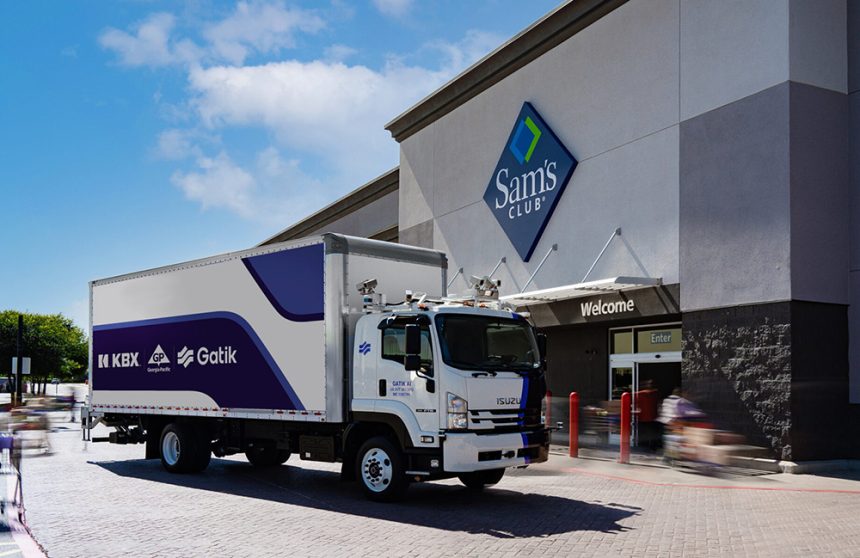
Autonomous trucking outfit Gatik just closed a $200 million Series D round, announced on August 25, 2026. The money isn’t going toward flashy robotaxis or long-haul moonshots — it’s aimed squarely at the unglamorous but lucrative middle mile: the short, repetitive hops between distribution centers and stores that retailers run day in, day out.
That focus is Gatik’s whole thesis. Rather than chasing the hardest possible autonomy problem, the company built its business around high-frequency regional routes stretching up to 400 miles. Its trucks handle dense highway networks at speeds up to 65 mph, then drop down to navigate surface streets — the kind of mixed driving that fixed, predictable routes make far more tractable for a machine.
Under the hood, Gatik runs an SAE Level 4 autonomous driving system integrated with Isuzu’s medium-duty platforms. The fleet consists of 26- and 30-foot trucks that run nearly 24 hours a day, hauling ambient, refrigerated and frozen goods. That around-the-clock cadence is the point: a driverless truck doesn’t need sleep, breaks or shift changes, which is exactly what makes the economics of repetitive regional delivery so attractive.
The company, founded in 2017, has racked up some numbers worth pausing on. Gatik says it has completed 85,000 fully driverless orders with a 99% on-time rate — figures that matter enormously in a sector where a missed delivery window ripples through an entire supply chain. It’s currently operating dozens of driverless trucks and is targeting more than 100 by the end of 2026.
What’s notable here is the discipline. Plenty of autonomous vehicle companies have burned through capital trying to solve everything at once. Gatik’s bet is narrower and arguably smarter: pick routes that repeat constantly, own them completely, and prove reliability before scaling. The $200 million is meant to push exactly that model further — expanding the network of distribution-center-to-store connections rather than pivoting into new, riskier territory.
For retailers, the appeal is straightforward. The middle mile is a persistent headache: expensive, driver-dependent and hard to staff. A fleet that runs continuously, sticks to its schedule, and doesn’t fatigue offers a genuinely different cost structure. And because these are fixed, high-volume lanes, every additional truck compounds the value of the mapping and operational data already collected.
None of this is aimed at consumers — there’s no gadget to buy and no price tag. But it’s a telling snapshot of where practical autonomy is actually taking hold. Not in the fantasy of your car driving you to dinner, but in the boring, relentless logistics that keep store shelves stocked. If Gatik hits its 100-truck goal, that quiet middle mile may become one of the first places driverless vehicles genuinely earn their keep.