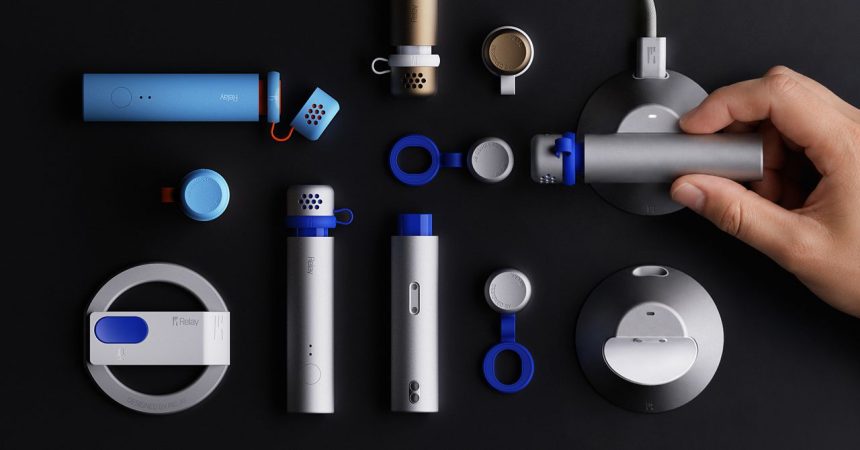
How much do you really hate typing? A London startup is betting the answer is: enough to buy a dedicated microphone for it. Relay, founded by two ex-Nothing employees — former head of AI and services Cookie Xu and hardware product manager Raymond Zhu — is launching its voice-to-text software today, with a companion gadget called the Relay Q due in early 2027.
The origin story is refreshingly mundane. At Nothing, Xu and Zhu used dictation software to draft most of their work messages, but kept hitting a wall: an office is a terrible place to talk to your computer. Whisper too quietly and the Mac misses you; speak up and your neighbor hears every word. Zhu even resorted to pulling out an earbud and holding it in front of his mouth. “It calls for dedicated hardware,” he says.
That hardware is the Relay Q, a cylindrical gizmo with a microphone on the end that, viewed from above, resembles the letter Q. Hold the top while speaking to trigger dictation on your computer or phone, or pop the button off and clip it to your shirt.
The software is macOS-only at launch, with Windows, iOS and Android planned. Setup asks you to pick a hotkey — the default is Fn — that activates Relay in any text field. The voice-to-text engine runs on Google’s Gemini models, and beyond transcription it offers contextual Skills: ask it to Slack a colleague and it launches the app, finds the recipient and drafts the text. There are presets for the likes of WhatsApp and Gmail, plus room to build your own.
That convenience comes with strings. Relay needs microphone access, and Skills require permission to snapshot your screen whenever it’s active — the same kind of system-level visibility that raised eyebrows with Microsoft’s Recall. Relay says data is stored locally, editable and deletable by the user, and passes through its servers only in transit to Google’s, without retention.
In beta testing on a Mac Mini, transcription proved solid rather than spectacular — occasional flubbed punctuation and inconsistent emoji handling (ask for a heart and it might just type “heart emoji”). It does strip filler, restate misspoken sentences, and adapt to custom rules, like skipping periods in casual Slack messages or translating notes to a coworker in another language. Dedicated hardware should shave the current hotkey delay.
Relay isn’t alone in chasing the whisper-to-text dream, but the company deliberately skipped a ring for a mic. You don’t need the hardware to use the app.