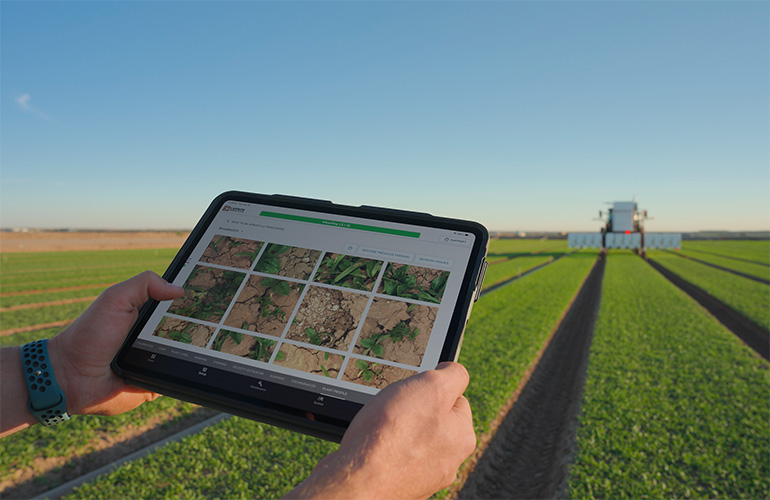
Precision farming just got a little more personal. Carbon Robotics has deepened its partnership with data-labeling specialist iMerit to power instant, in-field AI customization for its laser weeding machines — a move that lets farmers fine-tune how their equipment tells crops from weeds without waiting on a software update from headquarters.
At the heart of the announcement is a new plant foundation AI model and a companion tractor kit. Together they give growers the ability to teach the system on the spot, adapting to the specific crops, weeds and field conditions they’re dealing with rather than relying solely on a one-size-fits-all model. For anyone who’s watched a promising piece of ag-tech stumble over an unfamiliar weed species, that flexibility is a big deal.
None of this happens by magic. Carbon Robotics’ AI is trained on enormous volumes of labeled plant imagery, and that’s where iMerit comes in. The two companies have been working together since 2020, when Carbon Robotics went looking for a labeling partner to feed its Large Plant Model (LPM). Six years on, that relationship is the backbone of the company’s ability to reliably distinguish a cash crop from an invader at speed.
The technology it feeds is genuinely striking. Carbon Robotics’ LaserWeeder uses 30 high-power CO2 lasers to zap weeds with millimeter precision, hitting a claimed kill rate of 200,000 weeds per hour. The machine is pulled behind a standard tractor and relies on 12 high-resolution cameras paired with deep-learning AI to identify targets in real time — even at speeds of up to 6 mph. No chemicals, no manual hoeing, just carefully aimed light.
The second-generation G2 series line was introduced on February 10, 2026, and it’s already commercially available and deployed on farms around the world. These are serious industrial tools with pricing to match: new G2 models typically run from US$1,400,000 to US$1,700,000+. That puts them squarely in the realm of large-scale commercial agriculture rather than the family plot.
What makes the iMerit collaboration interesting isn’t a single new gadget, but the shift in how the intelligence gets updated. A plant foundation model provides the broad knowledge, while the tractor kit and in-field customization let that knowledge be sharpened locally, quickly, by the people who actually know the field.
The upshot for farmers is twofold:
- Faster adaptation to regional crops and weed pressures without a lengthy retraining cycle.
- Better accuracy as the system learns from the exact conditions it’s operating in.
It’s a reminder that the smartest hardware is only as good as the data behind it — and that in modern agriculture, the real battle is increasingly fought in the AI model as much as in the field.