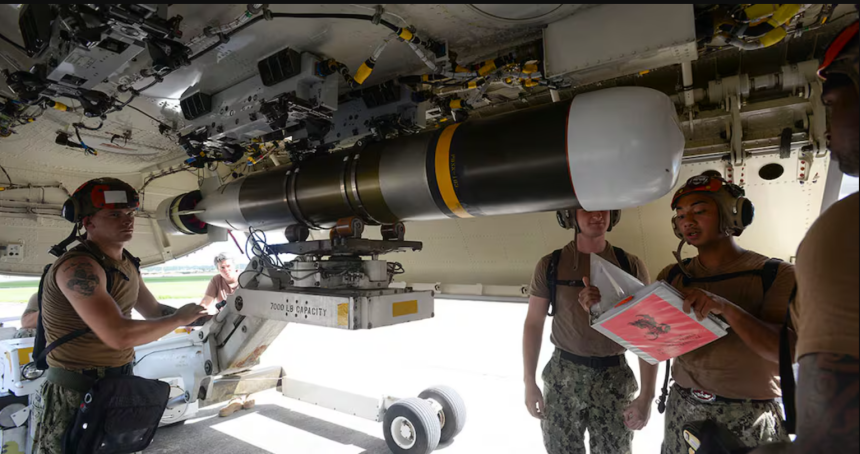
The US Navy is chasing a weapon that does something torpedoes have never really done well: stay quiet in the air before it ever touches water. The program is called Silent Anvil, and it’s currently in the market research phase, with the Navy weighing two competing design approaches for what it officially calls the Silent Anvil Air-Launched Torpedo, or SAA-LT.
The core idea is deceptively simple. A drone carries the weapon aloft, releases it, and instead of dropping straight into the sea or deploying a noisy parachute, the torpedo glides silently through the air toward its target area. That stealthy approach is the whole point — reducing the acoustic and visual signature during the delivery phase so the target has less warning before the weapon splashes down and goes to work.
What makes this program interesting from an engineering standpoint isn’t just the glide capability, it’s the constraints wrapped around it. The Navy has laid out strict size limits, which matters enormously when you’re talking about something that has to hang under a drone rather than a full-size maritime patrol aircraft. Every millimeter and gram counts when your launch platform is unmanned and payload-limited.
The Navy is currently evaluating two Silent Anvil designs. Rather than committing to a single concept early, it’s keeping options open while industry sorts out how best to marry a gliding airframe to a functional torpedo — two very different sets of aerodynamic and hydrodynamic problems that normally don’t share the same hardware.
Then there’s the timeline, which is aggressive. The Navy wants rapid prototype development: a working prototype within 18 months of any award. In defense procurement terms, that’s a sprint, not a marathon. It signals that the Navy isn’t looking for a decade-long science project — it wants something buildable, testable, and deployable in a hurry.
A few practical notes for anyone tracking this one:
- Silent Anvil is a US Navy program, not a finished product
- It’s in the Request for Information / market research phase — companies are still competing for the work
- The deadline for industry responses is Sept. 29
- There is no manufacturer named, no price, and no production date
Because the contract hasn’t been awarded, the field is wide open. That’s the real story here: the Navy is essentially crowdsourcing engineering ingenuity, setting the hard boundaries — small size, aerial glide, fast prototype — and letting the aerospace and defense sector figure out how to hit all three at once.
It’s a reminder that the drone era isn’t just changing how militaries watch the battlefield; it’s reshaping the weapons those drones carry. A torpedo that flies before it swims is exactly the kind of hybrid thinking that unmanned platforms make possible — and worth watching as the two designs move toward prototype.