Point a camera at someone in a British park and you could end up in prison. That, at least, is the impression left by a UK government booklet aimed at asylum seekers — and photographers are not amused.
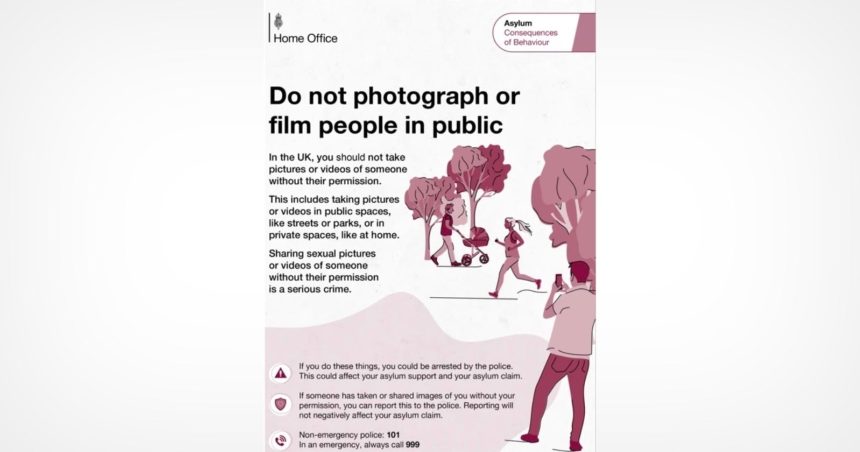
The nine-page guide, titled Understanding behaviours and expectations in the U.K., was published by the Home Office, the department that handles immigration, visas, policing and national security. In a section headed “Respect in public,” it tells readers: “In the U.K., you should not take pictures or video of someone without their permission.” It then goes further, adding that this “includes taking pictures and videos in public spaces, like in streets or parks.”
There’s just one problem: that isn’t the law. As Press Gazette reported, the booklet blurs a critical legal line. Taking or sharing sexual images of someone without consent is a criminal offence in the UK, and the guide correctly says so. But it fails to separate that specific crime from the far broader — and entirely legal — act of photographing people in public. The result reads as though pointing a lens at a stranger on the street is itself a punishable offence.
The National Union of Journalists (NUJ) has condemned the publication in blunt terms. In its statement, the union warned that the “misleading blanket” claim could fuel “increased hostility” toward photojournalists, exposing members to harassment, “wrongful accusations of criminality” and “unjustifiable stops by the police.”
“These statements misrepresent the law and risk misleading people on their rights and obligations,” the NUJ said. “Taking photos or videos of people in public without their permission is not inherently unlawful.”
The concern isn’t hypothetical. The union says its visual journalists already face routine obstruction, with members regularly having their right to photograph in public questioned. Feeding inaccurate information to newcomers — the very people who most need clear, correct guidance — only widens the gap between what the public believes and what the law actually says.
The NUJ is calling on the Home Office to correct the material and reissue accurate guidance to asylum seekers about photography and filming in public spaces.
This isn’t the first time official UK advice has left photographers shaking their heads. Last summer, the government suggested people delete old photos to conserve water during a drought, on the reasoning that data centres “require vast amounts of water to cool their systems” — a line that was promptly mocked online.
For a country with a long, proud tradition of street photography, the pattern is becoming a familiar one: official messaging that misstates, or at least mangles, the rules around pointing a camera at the world. The technology in your hands is legal to use. It’s the paperwork that keeps getting confused.