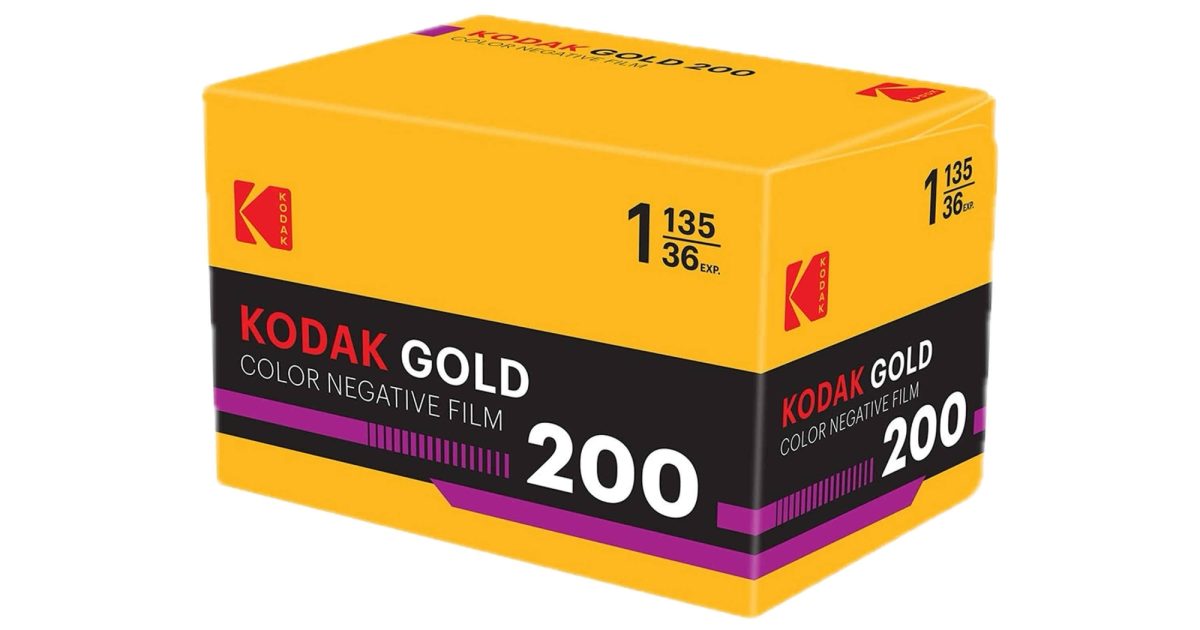
Kodak Gold 200 is the film almost everyone has shot and almost nobody brags about. Blue Moon Camera and Machine, the Portland, Oregon lab behind PetaPixel’s Film Friday column, made it the subject of a spotlight published on September 4, 2026, and the argument is blunt: this is a “consumer” emulsion that behaves far better than its place on the shelf suggests.
The backstory runs longer than most shooters realize. Gold was introduced in 1988 and is currently on its seventh generation, which was rolled out in 2007. Being a consumer film means two things. It aims at a much lower price point than Kodak’s professional stocks such as Portra or Ektar, and it has to be findable everywhere. Those two constraints produce Gold’s headline virtues: it is inexpensive, and it is ubiquitous.
Grain is where the trade-off shows up, and there is an actual number for it. Kodak rates the graininess of its films with a measure called the Print Grain Index (PGI): a print is made and the perceptual amount of graininess is gauged at a distance of 14 inches, the standard viewing distance for a 4×6 print. A PGI score of 25 is considered the lower visual limit of graininess, and higher numbers mean more perceived grain. The lineup, according to Blue Moon:
- Kodak Gold 200 — PGI 44
- Portra 160 — PGI 28
- Portra 400 — PGI 37
- Portra 800 — PGI 48
So Gold 200 is not just grainier than Portra 160, it is grainier than Portra 400 and sits within a hair of Portra 800, the fastest film in the Portra line. The lab’s counterpoint is that grain is not a defect by default — some photographers want that texture, and in Gold’s case the extra grain is simply what you trade for the lower cost.
Color is the other half of the story. Gold 200 puts out bright colors with fairly true renditions, sharp and clear, yet with a palette of its own. Blue Moon’s own field notes are specific: a staffer took rolls of Gold 200 in 120 to the Faroe Islands in the spring of 2023, where the landscape is dominated by browns and ochres, and the film rendered those shades richly. Blues come out clean and crisp, reds and oranges have real pop, greens land more muted.
There is a workflow argument too. When Agfa Vista was discontinued, the lab went hunting for a cheap replacement and landed on Gold 200 partly because, like Vista, it prints and scans consistently — a quality Kodak engineers built into their films across the range, not just the professional ones. For anyone sending film out, that consistency means better odds of a good result regardless of which lab handles it.
The short version of why it earns shelf space:
- Latitude: Kodak says you can underexpose it by two stops or overexpose it by three stops.
- Roll lengths: available in 24 and 36 exposure rolls — handy if you shoot half-frame and don’t fancy 72 pictures per roll.
- Medium format: as of 2022 it is once again available in 120, where the bigger negative also mutes the grain penalty.
The remaining wish, as Blue Moon puts it, is a 4×5 sheet version. Kodak has not announced one.