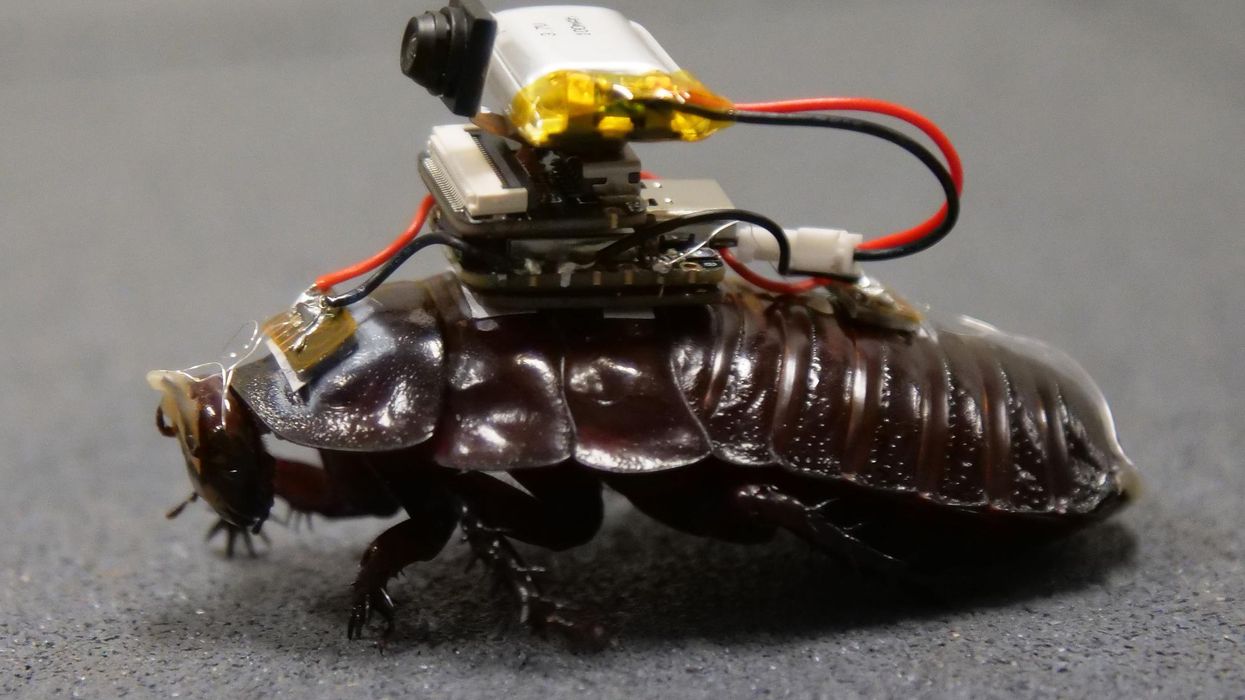
Picture yourself pinned under rubble after an earthquake, and the first thing that reaches you is a cockroach with wires on its back and a spring-loaded needle strapped above its wings. Unsettling, certainly. But the Paraborg — a paramedic cyborg insect from the University of Queensland’s Biorobotics Lab in Brisbane — is built to do what no search-and-rescue drone can manage yet: crawl into a collapsed building and deliver a drug dose while rescuers are still digging.
Building an insect-sized robot that can climb irregular surfaces, survive falls, carry its own power and still leave room for sensors is, as lab director T. Thang Vo-Doan puts it, “extraordinarily difficult.” An insect already ships with all of that, so the team grafts an electronic interface onto a living animal and borrows the rest.
The platform is the North Queensland giant burrowing cockroach (Macropanesthia rhinoceros), the world’s heaviest roach species at roughly 40 grams. Size matters twice: the insect had to carry over half its weight, and a bigger body is easier to operate on when implanting electrodes.
Each Paraborg carries a lightweight electronics pack with electrodes implanted into its antennae and its cerci, the small tail-like appendages at the rear. Firing those electrodes wirelessly from a handheld gaming controller steers the roach left or right, spurs it forward, or stops it. On top sits one of two payloads:
- A wireless camera for visual feedback;
- A remote-controlled injector that uses a spring to launch a drug-filled syringe at a nearby target; a chemical reaction inside the syringe then generates a puff of carbon dioxide, and that pressure injects the payload.
The team deliberately kept both off a single roach: the combined weight and bulk would impair mobility in complex terrain, and the extra energy demand would cut operating time. The plan is a swarm instead — scout roaches with cameras, medic roaches with needles.
The proof-of-concept numbers hold up. Steered over a 2.5-meter course past three checkpoints, the cockroaches launched their needles at an 8-by-10-centimeter silicone target. In 25 trials they completed the course every single time and succeeded at injecting the target 72 percent of the time. Positioned within 15 centimeters of the target, close-range injection succeeded 95 percent of the time.
The human side is trickier. The researchers concede that for someone already trapped or injured, a cyborg insect approaching could be “a little surprising or unsettling at first,” and suggest flashing lights, emergency markings, or a tiny speaker saying “help is on the way.” Vo-Doan is blunt about maturity: “We are not suggesting that this is a medical device ready to be used on people today.” Reliable wireless links inside collapsed structures, drug choice and dosage, sterility, needle safety and regulation all remain open questions. And the roach keeps a mind of its own — stimulation influences direction, but the insect generates much of its own locomotion.
The study appeared in Advanced Science as “Paraborg: Paramedic Cyborg Insects for In Situ Emergency Drug-Delivery,” and UQ announced the work on August 27, 2026. Biomedical engineers from the UNSW Medical Robotics Lab collaborated, and the team estimates cyborg insect rescue teams could be deployed in real emergencies within 5–10 years, given the resources to accelerate research.