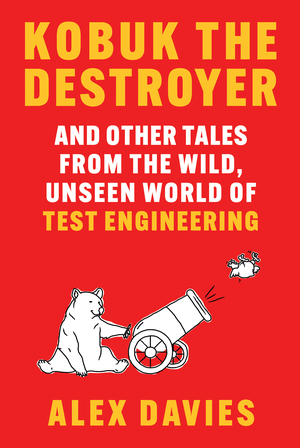
No astronaut has ever gotten food poisoning in space. That is not luck. It is the legacy of a problem NASA hit in the early 1960s, when Mercury gave way to Gemini and missions got long enough for crews to get hungry — a story told in Kobuk the Destroyer and Other Tales from the Wild, Unseen World of Test Engineering, the new book by Alex Davies published by W. W. Norton & Company.
Before NASA, US food inspection ran on human senses. The Federal Meat Inspection Act of 1906, passed after the outcry over Upton Sinclair’s The Jungle, created what became the Food Safety and Inspection Service: federal staff who checked livestock organoleptically — with their eyes, noses and hands — in an approach soon nicknamed “poke and sniff.” It caught the lesions that signaled tuberculosis and cysticercosis. It could do nothing about Escherichia coli, which humans cannot see, smell or feel, and it did not scale to plants butchering hundreds of animals an hour.
NASA’s lead food scientist, Paul Lachance, faced the opposite constraint: he could not test his way to safety at all. Screening every morsel is destructive testing — every bite that gets tested is one that cannot be eaten — so proving a batch absolutely safe would mean eliminating most of it. Lachance and his colleagues inverted the logic, controlling production so tightly that testing the finished food became unnecessary. They called it Hazard Analysis and Critical Control Point, better known today as HACCP (pronounced hassip).
The hazards NASA analyzed came in three flavors:
- Physical — crystallized Tang powder could break a tooth
- Chemical — the presence of pesticide residues
- Microbiological — the pathogens that posed the most serious threat in space
“We identified the critical steps that would make the difference between something being safe or not safe,” Lachance said. “The temperature, the pressure, whatever that criteria was, whatever that critical control point was.” A space-bound chicken was plucked, deboned, cut into pieces small enough to freeze-dry and cooked until sterile, then checked again on its way to the freeze dryer, into plastic packaging, and after vacuum-sealing.
Pillsbury, which produced crumble-free food for NASA and helped develop HACCP, folded the method into its own consumer lines after 1971. The FDA added HACCP-based rules for low-acid canned foods in 1973, the European arm of the World Health Organization recommended the approach in 1983, and the National Academy of Sciences declared it better than “random testing of foods” in 1985. Meat took longer. In 1993, Jack in the Box hamburgers sickened more than 700 people and killed four children; the Food Safety and Inspection Service hired 160 extra meat inspectors as a stopgap, then in 1996 ordered America’s meat processing plants onto HACCP. By 2004, illness from E. coli had dropped 42 percent, reaching a Centers for Disease Control and Prevention goal six years ahead of schedule, and the Food Safety Modernization Act of 2011 made HACCP-based safety plans mandatory for US food manufacturers.
The ceiling now is enforcement, not method. Foodborne disease still sickens 48 million people a year — one in six Americans — puts 128,000 in the hospital and kills 3,000. “The testing of finished products for food safety is foolishness,” says Larry Keener, president and CEO of International Product Safety Consultants, who sees industry and regulators as slow to use the strategy properly.
Kobuk the Destroyer runs 272 pages and went on sale in hardcover on September 8, 2026, at US$29.99.