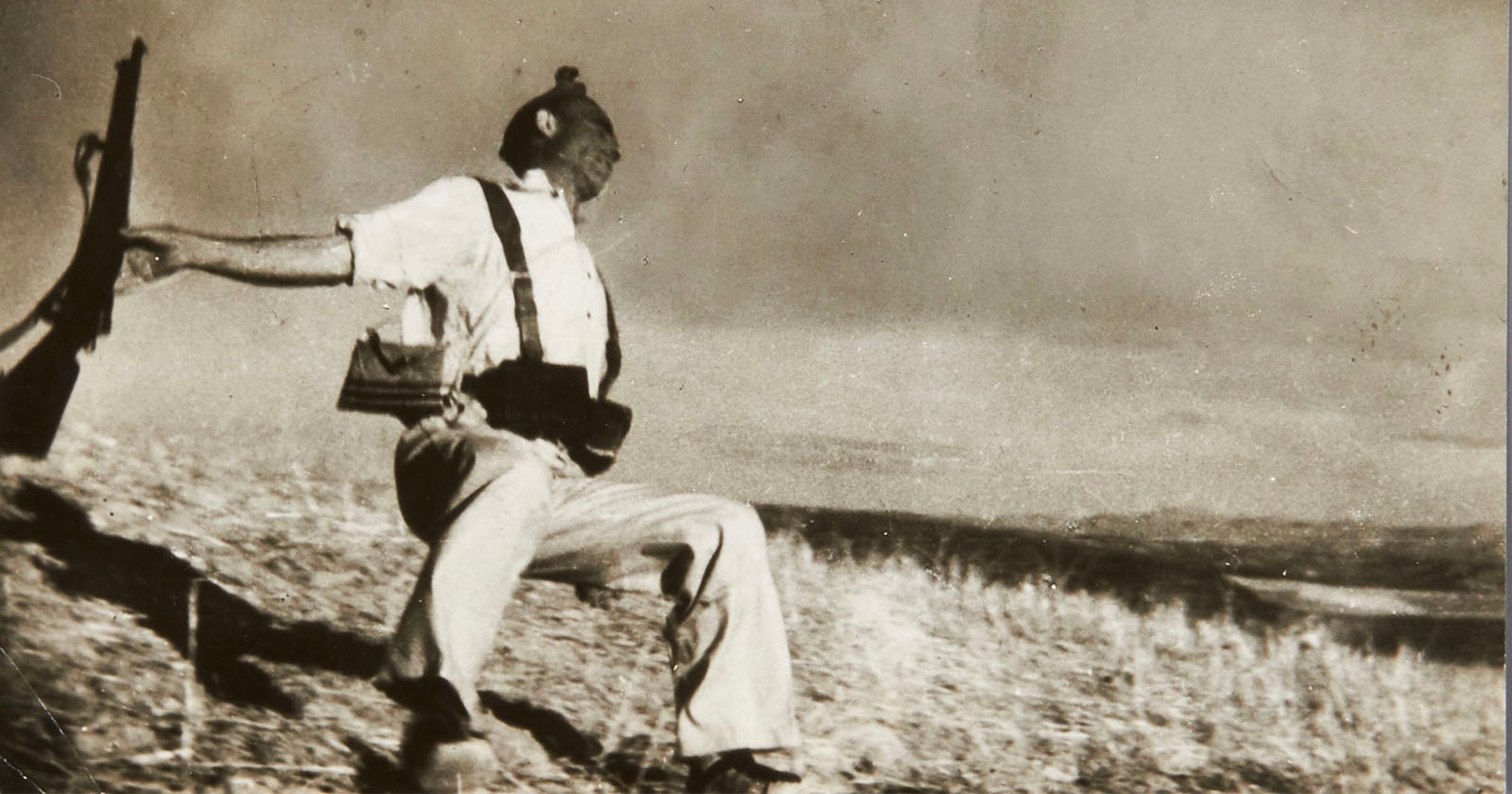
The most argued-over frame in photojournalism has a new question hanging over it, and it is not the usual one. For decades the fight about Robert Capa’s The Falling Soldier has been over whether the moment was staged. A Spanish researcher now says the more interesting problem is authorship — and that the shutter was pressed by Gerda Taro.
The claim comes from Fernando Penco, an archeologist and historian curating a 90th-anniversary exhibition at the University of Córdoba, who laid out his case to The Telegraph. His starting point is technical, and it is unusually hard to wave away.
The International Center of Photography, custodian of Capa’s archive, revealed in 2025 that the image was shot on a 6×6 medium-format camera. That single detail reframes everything, because in the field that day Capa was working with a 35mm Leica — a camera that cannot produce a square negative. Taro was carrying a Reflex Korelle, a 6×6 medium-format body.
“For me, everything hinged on one premise: If the photo was taken with the Reflex Korelle, we would have to seriously reconsider whether Taro took it,” Penco told The Telegraph.
From there the circumstantial evidence stacks up:
- Every other square-format photograph made near Espejo that day has already been attributed to Taro.
- Penco found frames shot by Capa showing Taro holding her Reflex Korelle earlier the same day in Villa del Río, the town from which the pair headed to the front.
- The negative of The Falling Soldier has never been found, so no physical original can settle the format question directly.
“Taken together, I think this is strong proof that it was she who took The Falling Soldier,” Penco said.
The picture’s official story has been eroding for a long time. It was taken on September 5, 1936, and Capa said it showed a Republican soldier at the instant he was shot during the Battle of Cerro Muriano. LIFE magazine’s publication turned it into a sensation and a caption — a man killed mid-stride — that outlived the scrutiny. In 2009, researcher José Manuel Susperregui placed the shot near Espejo instead, about 30 miles away, where no fighting occurred that day. Staged photographs were common in the Spanish Civil War, where access to actual combat was tightly restricted.
The attribution question also lands on a partnership that was always more tangled than the credit line suggested. Capa and Taro met in Paris in 1935 and worked closely together; “Robert Capa” began life as a fictional identity the two Jewish immigrants invented to appeal to American buyers. Taro was killed covering the Spanish Civil War and is remembered as the first female photojournalist to die covering combat.
Her profile is rising elsewhere, too. The Girl With The Leica, directed by Alina Marazzi and starring Emilia Schüle as Taro, had its world premiere at the Venice Film Festival in September 2026. If Penco is right, the caption on one of the century’s defining images needs rewriting as well.