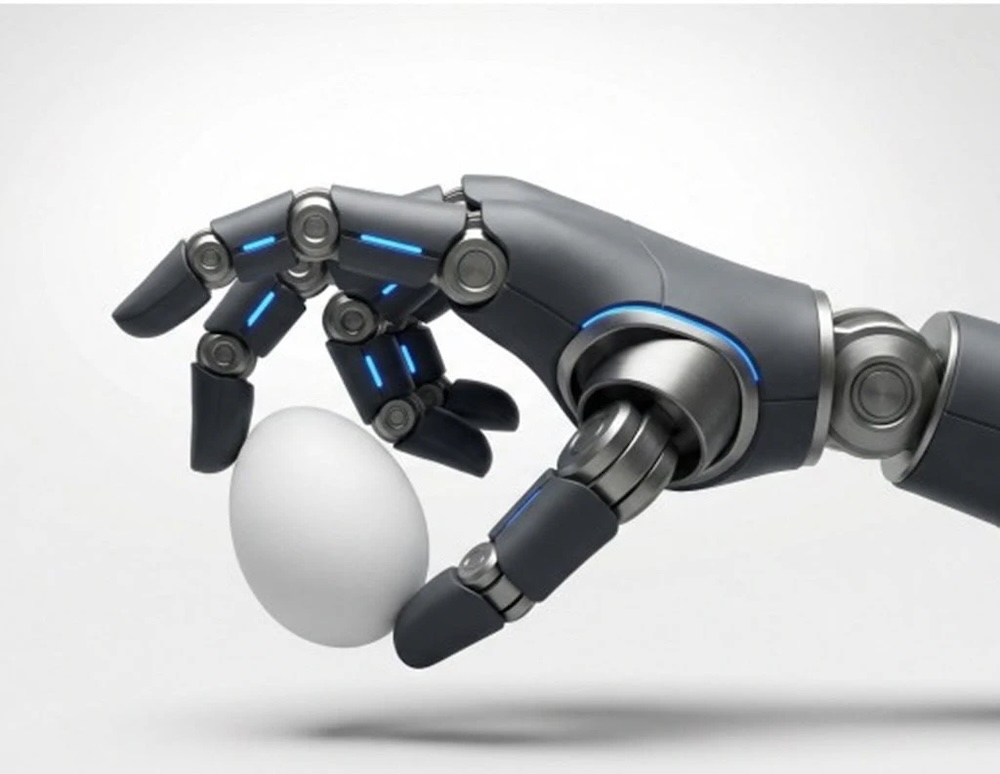
A humanoid robot that knows what to do is not the same as a humanoid robot that can do it. That gap between decision and motion is the subject of an essay published on The Robot Report on September 8, 2026 by Andreas P. Friedrich, managing director of technology and strategy at Allegro MicroSystems. His argument is blunt: artificial intelligence has run ahead of the electromechanical hardware that has to carry out its instructions.
Start with the contrast he draws. An industrial robotic arm may have six or seven axes and spend its entire working life bolted to a factory floor. Weight at the base matters relatively little, thick copper cables can deliver power, motor drives can live outside the robot in control cabinets, and cooling infrastructure can be as bulky as the job demands. A humanoid with 30 or more degrees of freedom gets none of those luxuries. Every additional joint brings its own motors, power electronics, position and current sensing, control and safety functions, and all of it travels with the machine. Every gram adds to the energy needed to move, and every millimeter of electronics competes for space inside an arm, a leg, a hand or a finger. The paradox bites hardest in dexterous hands, where the joint stops being a component and becomes a system-level design problem.
Power architecture shows how tightly the electrical and mechanical sides are tied together. Early robotic systems were built around relatively low-voltage distribution. More advanced mobile robots and humanoids are moving toward 48V DC architectures, and the physics is unglamorous but decisive. For the same delivered power, going from 12V to 48V reduces the required current by a factor of four, which lets designers use thinner wiring and strip copper weight out of the whole machine. Because resistive losses scale with the square of current, that same change cuts wiring losses by a factor of 16. Cooler electronics are far easier to bury in a joint that has no room for elaborate cooling.
There is a catch. Motors do not only consume energy; during rapid deceleration they can behave as generators, producing transient voltages considerably higher than the nominal DC bus voltage. The joint electronics have to ride that out without damage or loss of control.
What each joint has to handle, according to Friedrich:
- Closed-loop execution. Position, current and torque information feed a loop that measures actual movement against commanded movement and adjusts the motor continuously.
- Sensing that fits. A shoulder and a finger have very different mechanical and packaging demands. Large motors generate electromagnetic interference that sensing must tolerate; small joints are cramped and still need precise position data. No single sensing architecture covers every joint.
- Safety inside the machine. A humanoid working next to a factory worker or in a home cannot rely on the cages and keep-out zones of industrial automation, so fault detection and safe-state behavior have to be designed in from the start.
- Integration at the silicon level. Shortening the physical and electrical distance between sensing, control and actuation reduces PCB routing complexity, thermal hotspots and parasitic effects.
Friedrich reaches for automotive engineering as the precedent. Electronic steering and braking already combine high-power electromechanical actuation with sensing, diagnostics and functional safety, and the architectural lesson transfers even though the requirements differ.
His favorite illustration is deliberately mundane: handing someone a cup of tea. The arm cannot simply travel to a coordinate. It has to know where its joints are and control the torque it applies while conditions change under it. That is the frontier he points to next, moving humanoids from seeing and moving to feeling, with force and touch sensing built into fingers and fingertips so a robot adjusts on contact the way a hand does.