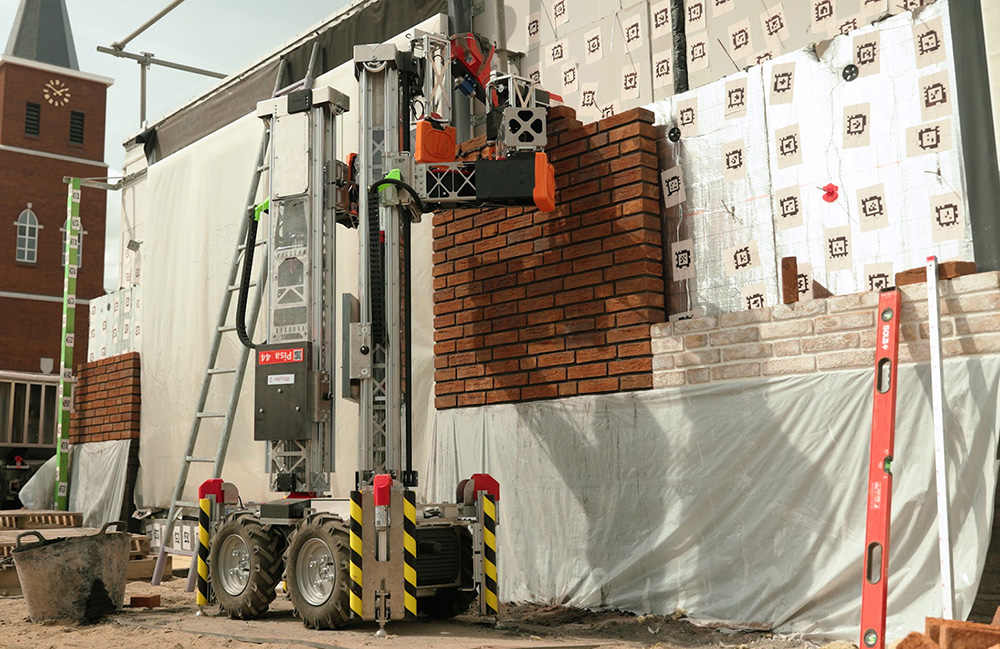
Most construction robots live in demo videos. Amsterdam-based Monumental took the other route and put its machines on live jobs, where they get rained on, blocked by late deliveries and confronted with bricks nobody trained them for. In an interview published by The Robot Report on September 9, 2026, co-founder and CEO Salar al Khafaji laid out what laying bricks has taught the company about automating everything else on a site.
The pitch begins with arithmetic, not ambition. “Construction is a really interesting use case for robots and AI, because it’s one of the few industries where the narrative is really not AI and robots coming in to replace labor to make things cheaper or redundant,” al Khafaji said. “It’s literally there’s not enough people to do the work.” The supporting figures are blunt: 92% of contractors struggle to fill construction roles, and the U.S. is short 4.5 million homes. In Western Europe, he added, bricklayers are the No. 1 job-shortage category in the U.K., the Netherlands and Germany.
Monumental’s answer is a small crew of machines rather than one do-everything humanoid:
- Pisa is the bricklayer. “It has two tiny tower cranes, basically with two arms. It’s non-humanoid,” al Khafaji said. One arm picks and places the brick, the other extrudes mortar between courses.
- Petra keeps Pisa fed with bricks.
- Panama supplies the mortar.
- Pathion, a mushroom-shaped unit, handles communication between robots and brings 4G, 5G, Starlink and Wi-Fi to the site.
The fleet runs on Atrium, Monumental’s own software platform. And here is the part that matters strategically: only about 10% of the technology is brick-specific. The other 90% is generic site robotics, which is why al Khafaji sees room where rivals do not. “We’re seeing a lot of autonomous construction robotics companies that are doing excavators, ground movers, Caterpillar-like machines. These are heavy machines, they’re not precise,” he said. That segment is well funded: Gravis Robotics has raised $200 million, TerraFirma $115 million and Bedrock Robotics $270 million.
Monumental sells itself as a subcontractor instead of chasing enterprise integration, which suits an industry where, as al Khafaji puts it, “No one is vertically integrated. It is fragmented.” The catch is that real sites bite back. “You can do everything right, but if you show up and the bricks were not delivered, you’re not going to lay bricks,” he said. The sharpest lesson came from colour. Days before one deployment, the team learned the job would use pitch-black bricks its computer vision models had never seen. “I’d never seen them before,” al Khafaji said. Retraining on that footage fixed it, and made the wider point: “You get real-world data.”
The company was founded in 2021 and now lists 100+ robots, 100+ homes and 40+ delivered projects across the Netherlands, the U.K. and the United States, with 130+ staff and $60M+ raised. Of that, $32 million arrived on July 17, 2026 in a Series B led by Khosla Ventures, with Hummingbird and Plural taking part, earmarked partly for the U.S. launch.