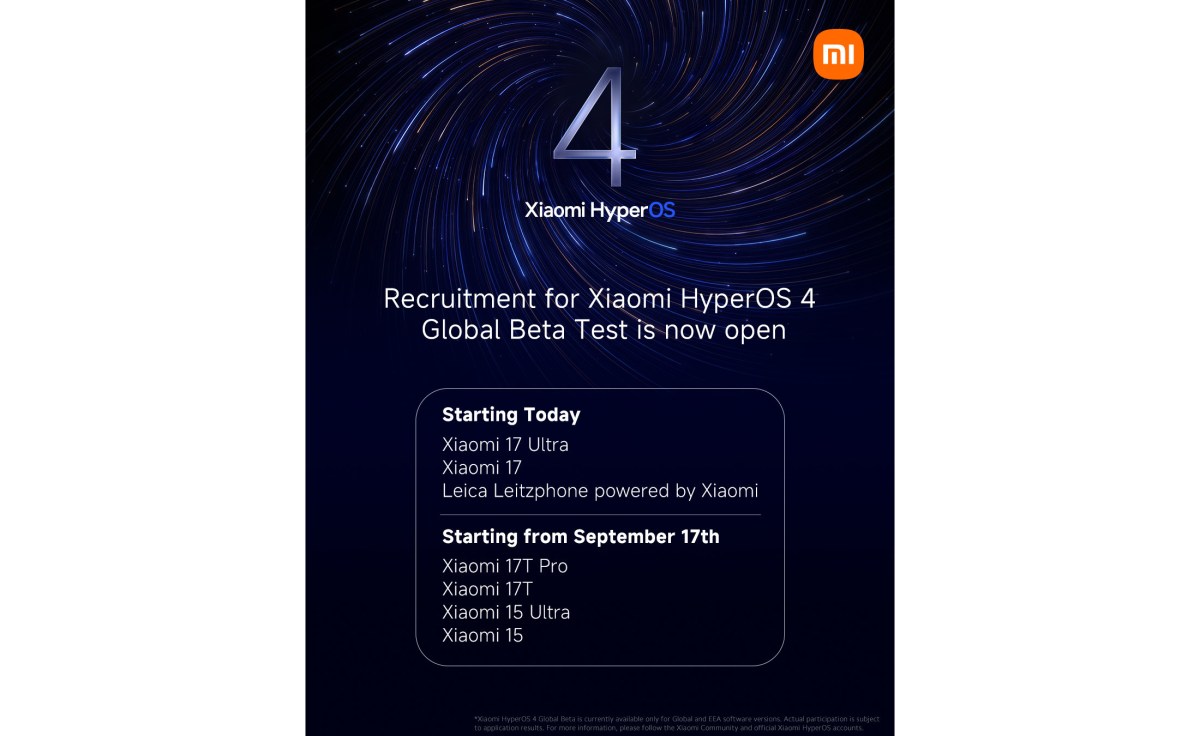
Xiaomi has opened beta recruitment for HyperOS 4 on Global and EEA firmware, and the sign-up window is already live. Recruitment for global (MI) and European (EU) builds began on September 10, 2026, roughly a month after the platform was first shown in China.
The opening wave is deliberately narrow. Only three handsets qualify at the start:
- Xiaomi 17 Ultra
- Xiaomi 17
- Leica Leitzphone by Xiaomi
A second wave arrives on September 17, 2026, adding the Xiaomi 17T, Xiaomi 17T Pro, Xiaomi 15 and Xiaomi 15 Ultra. That is a reasonable spread of last-generation and current flagships, which is exactly the pool Xiaomi needs if it wants crash reports from hardware people actually carry around.
Signing up is done entirely inside the Xiaomi Community app: open it, tap Me, then Beta testing, then Recruiting test, and fill in the questionnaire. It is a screening form, not a queue ticket, so filling it in does not guarantee a slot.
There are conditions attached. The phone has to be running the latest stable HyperOS 3 build, the Xiaomi Account you register with must be the one signed in on the device, and only devices carrying supported Global and EEA firmware are accepted. Xiaomi also notes that for certain beta versions, Xiaomi Account verification may be required. Accepted testers receive the build through their device page, and Xiaomi has not committed to a fixed rollout timeline for it.
The warning worth reading twice concerns the exit route. Going back to stable HyperOS 3 is not an over-the-air rollback. It means manually flashing firmware, with everything that implies about backups, patience and the risk of getting it wrong. Beta software carries bugs by definition, and this one is emphatically not a daily driver candidate.
What testers are signing up for
HyperOS 4 is built on Android 17 and leans on a new visual direction Xiaomi calls Life Aesthetics, with a Soft Light Glass treatment of translucent surfaces, layered cards and blur. On the assistant side, Super XiaoAi 2.0 is powered by Xiaomi’s MiMo V2.5 large language model. The platform was unveiled in China in August 2026, with beta builds rolling out there in batches before this Global and EEA recruitment opened.
A firm public release date for the Global version has not been announced. For anyone with a Xiaomi 17 Ultra sitting in a drawer as a spare, the beta is an early look at where Xiaomi’s software is heading. For anyone with one phone and a calendar full of meetings, the sensible move is to wait for stable.