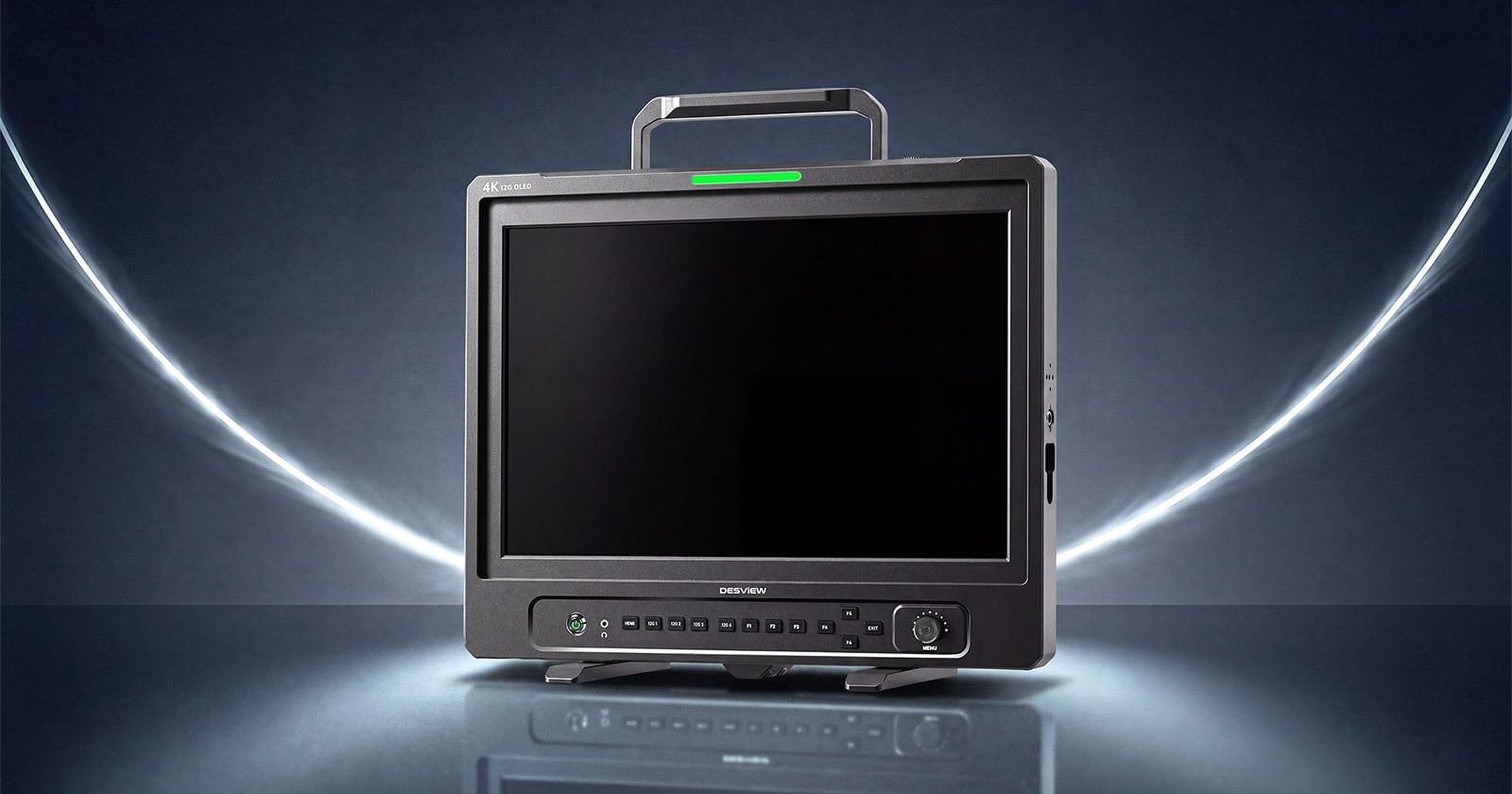
Desview unveiled three new professional field monitors on September 11, 2026, and the trio shares a single obsession: putting a big, bright, accurately calibrated panel on set without dragging a grading suite along. The range is led by the Core OL16 Ultra 12G, sits in the middle with the Core OL16 Max, and starts with the OL14 Pro.
The Ultra is the one built for high-bandwidth cinema rigs. It uses a 16-inch AMOLED display with 3840 x 2400 resolution, a 16:10 aspect ratio and 331 PPI, which is dense enough that pulling focus by eye stops being an act of faith. Typical brightness is just 400 nits, but peak brightness hits 1200 nits, which is what makes an HDR workflow viable outdoors rather than merely theoretical.
- Panel: 16-inch AMOLED, 3840 x 2400, 16:10, 331 PPI
- Brightness: 400 nits typical, 1200 nits peak
- Color: 100% DCI-P3, 10-bit color depth, 100,000:1 contrast
- Video I/O: one HDMI input and four 12G-SDI ports
- Power: XLR-type DC input, 5.5-2.1mm threaded DC input, V-mount batteries
The Core OL16 Max keeps the same 16-inch footprint with an OLED panel, 3840 x 2400 resolution and 1200-nit peak brightness. The meaningful cut is bandwidth: it carries four 3G-SDI ports rather than four 12G-SDI ports, so single-link 4K60 over SDI is off the table. Everything else stays recognizably the same monitor, down to the dual speakers, 3.5mm headphone jack and tally indicator.
The OL14 Pro is the compact option, built around a 13.3-inch AMOLED panel with 1920 x 1080 resolution and a 16:9 aspect ratio. Resolution drops, but the panel still has 1200-nit peak brightness and covers 100% of the DCI-P3 color space, so it is a smaller window onto the same color science rather than a cheapened one. It has 3G-SDI with three slots instead of four, and it is the only model of the three with two HDMI inputs instead of one, which is a quiet win for anyone running a two-camera interview setup.
All three lean on the same toolset. There is multi-view monitoring with dual-view and quad-view split screens, with per-window LUT support so each feed can carry its own look. Exposure duties are handled by professional waveform tools with histogram, vectorscope, zebra and false color, and anamorphic desqueeze is on board for scope shooters. Each monitor supports professional LUTs and imported 3D LUTs, and also accepts Calman’s 3D LUTs and full calibration to ensure consistent, accurate color.
Pricing tracks the hierarchy exactly. The Desview OL14 Pro is $1,299, the OL16 Max is $1,999, and the Core OL16 Ultra 12G is $2,999. None of these are impulse buys, but a 12G-SDI reference-grade 16-inch panel has never lived in bargain territory, and Desview is undercutting the usual suspects rather than joining them.