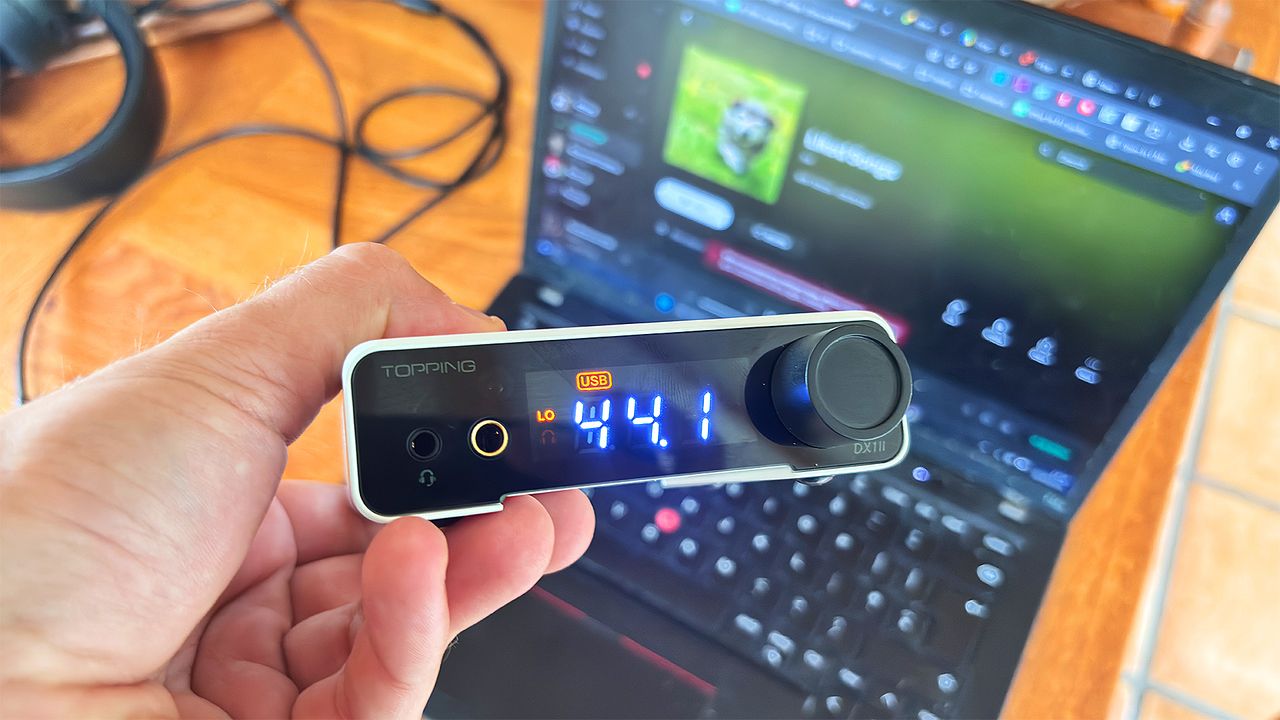
Squeeze a full DAC, a headphone amplifier and a preamp into something barely bigger than a wallet, sell it for US$119, and you have the makings of a desktop bargain. That is the pitch behind the Topping DX1 II, and on paper it is a convincing one. What Hi-Fi? published its verdict on September 11, 2026, and handed the little Topping three stars out of five, with four each for build and features but only three for sound.
Start with the hardware, because this is where the DX1 II earns its keep. The digital-to-analogue stage is built around an ES9039Q2M ESS chip in a dual-DAC arrangement, so the left and right channels are converted independently. Input handling falls to a 16-core XU-316 XMOS chip, and the analogue stage is fully balanced. Maximum file support is 32-bit/384kHz PCM and DSD256. There is no Bluetooth.
Connectivity is unusually generous for the money:
- Inputs balanced 4.4mm, single-ended 3.5mm, USB-C, optical
- Outputs balanced 4.4mm, single-ended 3.5mm, RCA, optical
- Dimensions (hwd) 3.2 x 10 x 10cm, weight 275g
- Power USB-C only, no battery
That single USB-C port carries both power and audio, which means a laptop can feed the DX1 II on its own. Topping also pitches the unit at gamers, and What Hi-Fi? notes it will happily sit between a PlayStation 5 or Nintendo Switch and your headphones. An iPhone, however, cannot supply enough power to run it. On Topping’s own store the 4.4mm balanced headphone output is rated at 1000mW x2 @32Ω, and the DAC ships in black, silver and white with an infrared remote in the box.
An LED display reports file rate, current input and volume, and stays legible from across a desk. The single rotary dial handles volume and input switching, though What Hi-Fi? found it fiddly enough to recommend reaching for the remote instead. Tweakers get plenty to play with: the Topping Home web control platform opens up gain, inputs and eight digital filters, while the desktop app adds a 10-band parametric equaliser with frequency, gain and bandwidth adjustment across left and right channels, plus three profiles saved to the DAC itself.
Then comes the listening, and the mood cools. Paired with Beyerdynamic DT 990 Pro X and Røde NTH-100 headphones, the DX1 II delivered a clean, uncluttered and reasonably detailed sound that bettered a ThinkPad’s internal chip. Against a MacBook Pro 2026, though, the gap narrowed to almost nothing, and the laptop was judged the more expressive performer through the midrange. A DSD64 Billie Jean exposed the deeper problem: poise and precision, but flattened dynamics and a shortage of drive. The five-star iFi hip-dac 3 at £149 / $149 sounded richer, and the AudioQuest DragonFly Cobalt at £179 / $200 brought more spark.
The conclusion, then, is a familiar one for budget hi-fi. The DX1 II is versatile, solidly made and impressively specified for the price, but What Hi-Fi? found its clinical streak left the music sounding listless, and withheld a full recommendation.