Regulation usually hits a hardware company like a tax. For Hylio, the Texas builder of agricultural spray drones, it has worked more like a tailwind.
On December 22, 2025, the U.S. Federal Communications Commission added all foreign-manufactured unmanned aircraft systems, plus foreign-produced UAS critical components, to its Covered List. On July 28, 2026, the commission extended the same treatment to advanced robotic devices. The mechanism is the same in both cases and it is brutally simple: a new model in a covered category cannot obtain FCC equipment authorization, and without that authorization it cannot be lawfully imported or sold in the United States unless it receives Conditional Approval.
Hylio, founded in 2015 and building its aircraft in Richmond, Texas, spent years preparing for a rule it could not have known was coming. Co-founder and CEO Arthur Erickson told The Robot Report that a U.S.-centered supply chain was never a compliance exercise. “That’s a core tenet of our philosophy… way before it was officially on any sort of legal radar,” he said, adding of the eventual crackdown: “There was part of me that knew that was going to be a problem.” Critical components come from domestic and allied manufacturers.
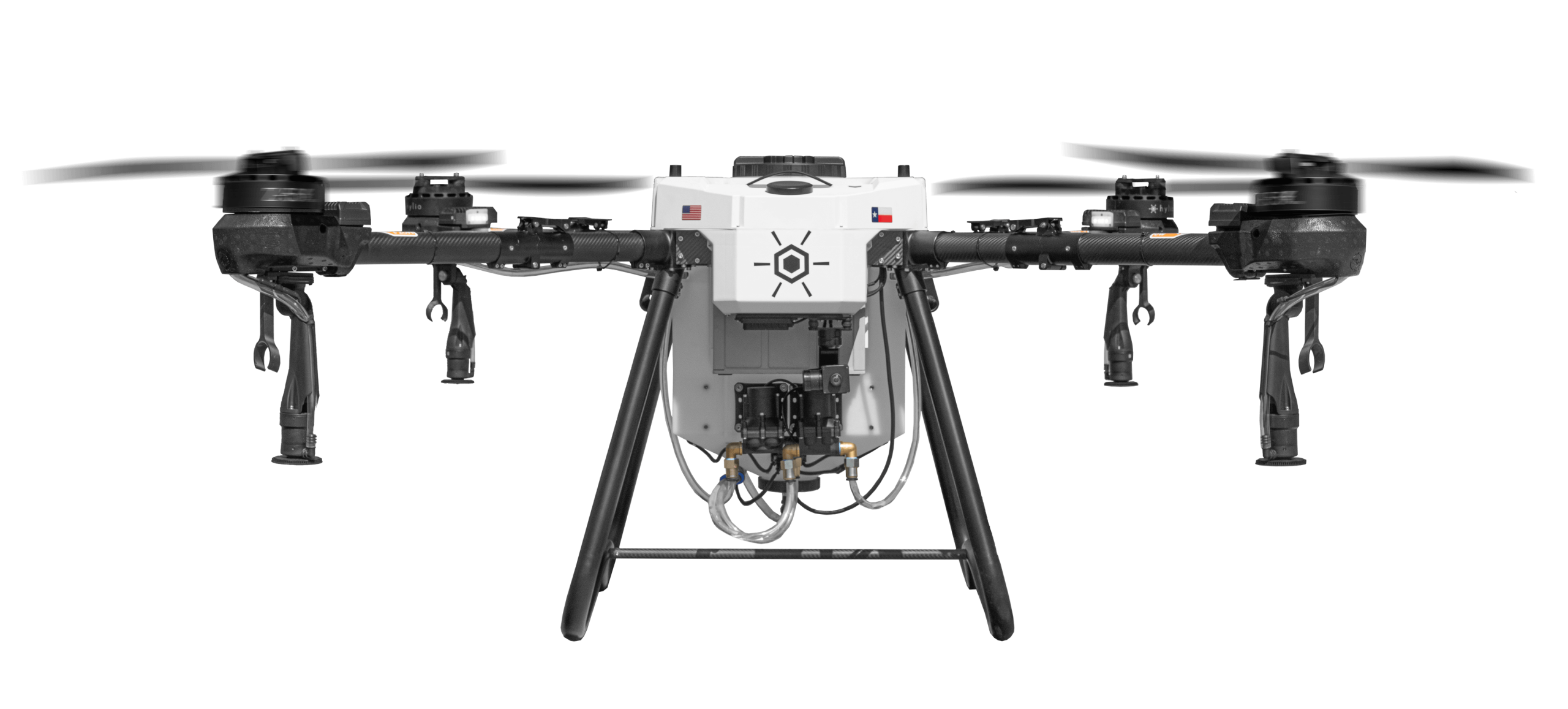
The current lineup is built around tank size rather than gimmicks. PEGASUS carries 2.5 gallons of liquid or 4 gallons of dry product, ARES handles 13 and 20 gallons, and ATLAS tops the range at 30 and 45 gallons. The PHOTON scout drone flies the imaging half of the job. Hylio lists the ARES as model HYL-150, with a maximum payload of 110 lb. and a swath of up to 40 ft., manufactured in Texas. Digital flowmeters handle dosage precision, and the company describes its systems as 100% NDAA-compliant.
The other half of the story is farm economics, and it is less cheerful. Grain, soybean and wheat prices have been sliding for years. Erickson points to corn dropping 50-70%, while grower costs, driven by fertilizers, pesticides and herbicides, have climbed 50-60% above pre-COVID 2019 levels. That squeeze is exactly why a machine that puts chemicals only where they are needed gets a hearing.
Getting airborne legally is the part farmers underestimate. Between the FAA and the FCC, a commercial operator needs several licenses before the first tank is filled. “It’s not usually the case for any product or equipment that you need to do three or four different licenses first,” Erickson said. His advice is unglamorous and correct:
- “Make sure you have all of your licenses in place before you actually start doing any real commercial operations.”
- Plan the deployment: “Think about where you’re going to apply it… Maybe you start off with 20% of your land.”
Rules that change this fast are a burden for everyone. They are a moat only for the companies that built for them first.