Software companies buying hardware companies is a familiar story, but rarely does the hardware weigh over a tonne and drive itself through minefields. On September 10, 2026, Swarmer entered into a definitive agreement to acquire Ratel Robotics, the Kyiv-based maker of unmanned ground vehicles, in a cash-and-stock deal worth up to $224 million if every earnout milestone is met.
Swarmer, headquartered in Austin, Texas and founded in 2023, does not build machines. It writes vendor-agnostic autonomy software that coordinates hundreds of unmanned platforms in real time, with swarms scaling to as many as 690 drones. The company’s software first went into combat operations in April 2024 and has since supported more than 100,000 combat missions. Swarmer trades on Nasdaq under the ticker SWMR, and its board is chaired by Erik Prince.
Ratel Robotics, also founded in 2023, supplies the other half of the equation. Its modular UGVs handle battlefield logistics, casualty evacuation, reconnaissance, de-mining, strike tasks and drone launch. The company has secured $86 million in contracts for 2026 and accounted for roughly 37% of the 11 billion UAH ($246.85 million) that Ukraine’s Ministry of Defense spent on unmanned ground vehicles between January 1 and April 18, 2026. It holds NATO NCAGE code A3X8J with AQAP 2110 quality certification.
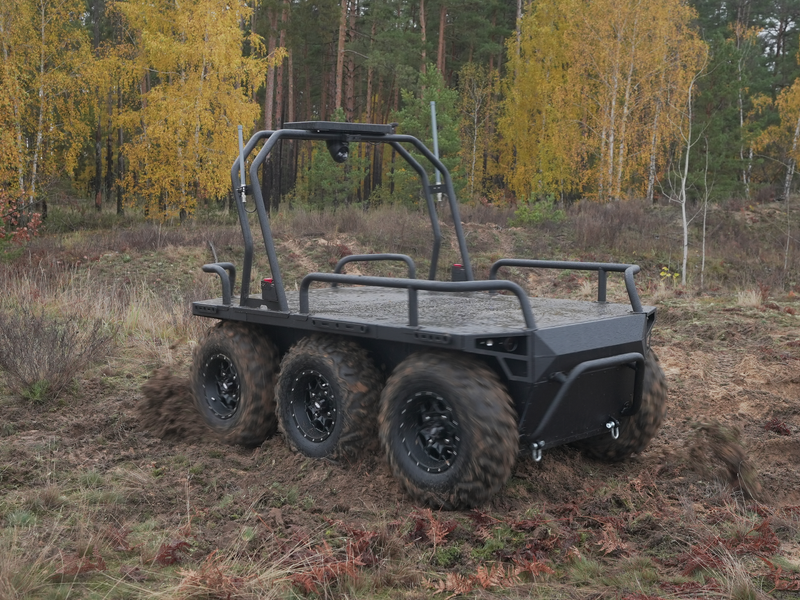
The two headline platforms are the Ratel H and the Ratel M. Both are remotely controlled machines built for cargo transport, ammunition delivery and evacuation of the wounded, both take specialized modules, and both move at a deliberate walking pace rather than a sprint.
- Ratel H — useful load of 500 kg or more, 1185 kg empty and 1685 kg with payload, speed of 8 km/h, dimensions 2480x1400x1820mm, daytime and night cameras.
- Ratel M — payload of more than 200 kg, 885 kg empty and 1285 kg with payload, speed of 8 km/h, dimensions 1800x1400x1820mm, configurable with medical stretchers for casualty evacuation.
Each system ships with the platform itself, a ground control station, a repeater for a multicopter relay, a charging station and satellite-based remote control.
The logic of the merger is that a ground robot is not just a cargo mule but a mobile launch pad. “Combining a battle-tested launch platform with our combat-proven autonomy software is the key to creating versatile, interoperable solutions,” said Alex Fink, Swarmer co-founder, president and U.S. CEO. Ratel CEO Taras Ostapchuk framed it as a pairing of domains: “Together with Swarmer, we plan to combine ground capabilities and aerial capabilities with increasing levels of autonomy.”
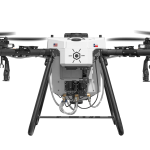
Ratel’s roadmap already stretches beyond wheels. The company is developing two unmanned aerial vehicle variants, mobile workshops and solar-powered trailers. More than 300 Ratel employees are expected to join Swarmer at closing, bringing the combined headcount to nearly 500. The transaction remains subject to customary conditions and the required legal, regulatory and shareholder approvals.