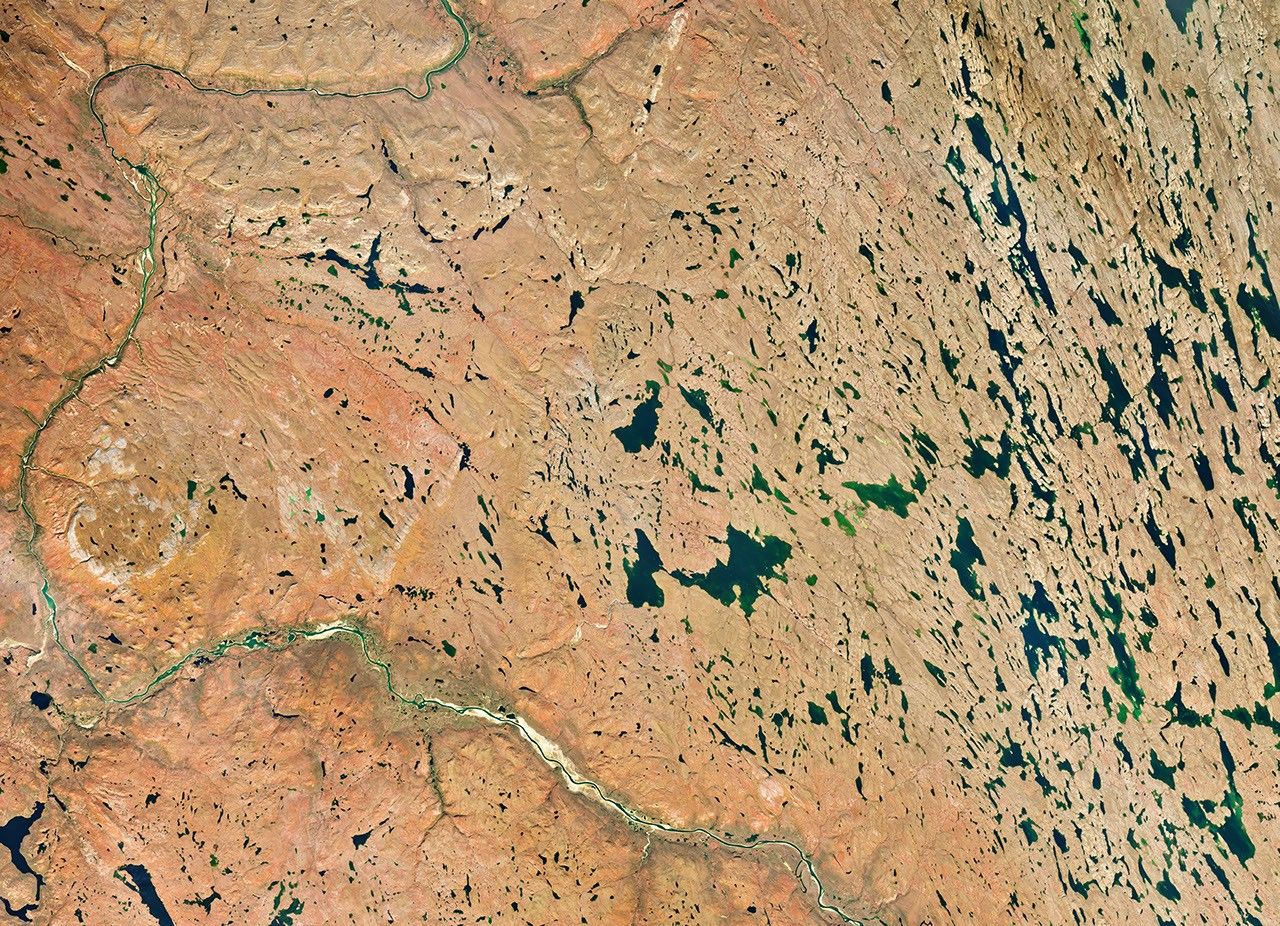
Most of North America spent early September 2026 still waiting on a few red and orange leaves. From orbit, one corner of the continent had already changed color. On September 14, 2026, NASA Earth Observatory published a before-and-after image pair of Nunavut, in Canada’s far north, where the tundra had turned from summer green to a solid carpet of orange.
Both frames were shot by the Operational Land Imager (OLI) on Landsat 9, which orbits 438 miles (705 kilometers) above Earth, according to PetaPixel. They show the same stretch of the Coppermine River winding through low shrubs and tundra upriver of Kugluktuk, a small community at the river’s mouth. The first was captured on July 27, 2026, when the landscape was green and dotted with lakes. The second came on September 6, and by then the same ground had gone red and orange, with only a little green left along the riverbanks. The images were produced by Michala Garrison of NASA Earth Observatory from U.S. Geological Survey Landsat data.
The timing is no surprise. The region is covered in willow and birch shrubs, blueberries, bearberries and other low tundra plants that turn red, orange and yellow every fall. A NASA and South Dakota State University analysis of seven years of satellite data found that foliage there starts to change in early September and peaks around mid-month. That puts it among the first places in North America to change color.
The show is short, too. “But blink and you might miss it,” NASA notes. The same analysis found that far northern regions tend to have shorter periods of peak color, sometimes a week or less, than many areas at lower latitudes.
NASA’s write-up also explains the chemistry behind the colors:
- Chlorophyll makes leaves look green because it absorbs red and blue light. It isn’t stable, so plants have to keep making it, and that takes plenty of sunlight and warmth.
- As days shorten and temperatures drop, chlorophyll levels fall and the green fades.
- Carotenoids absorb blue-green and blue light, so leaves look yellow once the chlorophyll is gone.
- Anthocyanins absorb blue, blue-green and green light, so the light they reflect looks red.
The imagery stands out because of the summer that came before it. NASA points to a season of remarkable heat across North America and cites NOAA’s report on the warmest summer on record for the contiguous U.S. By early September, crisp fall weather still felt far off for much of the continent, but the subarctic ecosystems of Nunavut had already moved on.
For photographers, Nunavut gives an early hint of what’s coming further south. PetaPixel notes that peak color usually reaches places like Vermont, New York and Maine in late September and early October, depending on location and elevation. Higher ground generally turns first. NASA also invites citizen scientists to log leaf color changes through the GLOBE North American Phenology Campaign, which feeds long-term environmental databases.