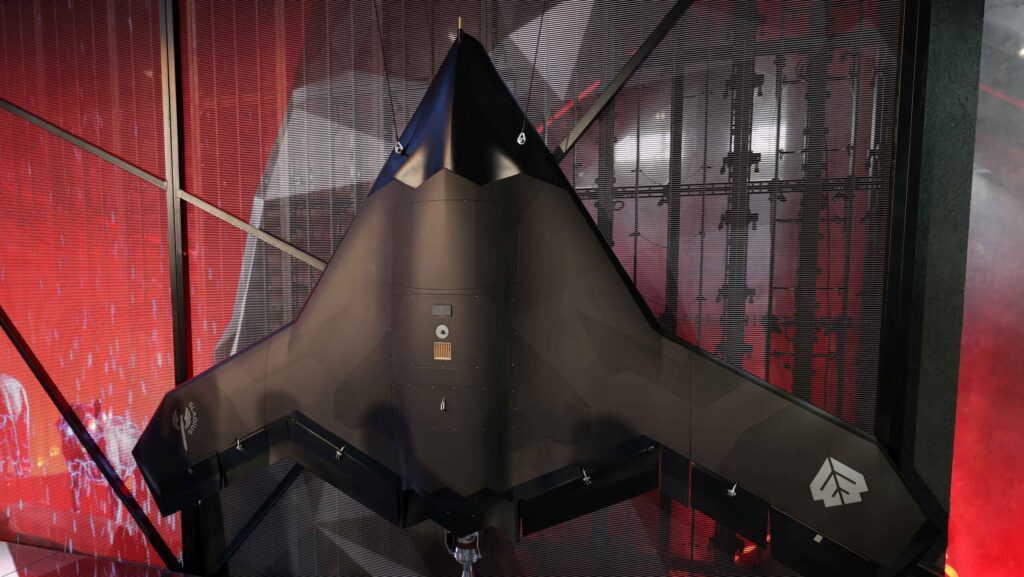
Park it next to a photo of a B-2 Spirit and you would struggle to tell them apart at a glance — until you notice the wingspan is measured in feet rather than yards. Poland’s WB Group pulled the covers off the Warmate 30, also designated Gladius 2, at the MSPO defence exhibition in Kielce, which ran from 8 to 11 September 2026. It is a turbojet-powered loitering munition, and the resemblance to Northrop Grumman’s bomber is not styling for the sake of it.
The shape is doing a job. WB Group describes a low-profile flying-wing configuration built around a composite airframe with reduced radar and thermal signatures. “The Warmate 30 UAV is designed in a low-profile flying-wing configuration with reduced radar and thermal signatures,” said WB Group spokesperson Remigiusz Wilk. A flying wing has no vertical tail surfaces to throw radar energy back at an emitter, and burying a small jet inside the body keeps the exhaust plume out of the direct view of an infrared seeker. Both matter when the whole point of the aircraft is to fly into defended airspace and not come back.
The numbers WB Group has put on the table:
- Warhead: interchangeable, 30 kg — the figure the name refers to
- Maximum speed: roughly 450 km/h (280 mph)
- Cruise speed: over 150 km/h
- Range: approximately 250 km
- Endurance: more than one hour
- Propulsion: Polish-made turbojet engine, production of which started in 2026
Launch is rocket-assisted. The munition is fired from a containerised launcher intended for both land and naval use, and it can also go off a launching ramp compatible with Gladius 1 platforms such as BSP-U or FT-5. WB Group says the system can be readied for use in under five minutes, which is the sort of claim that only matters if you are trying to shoot at something that will have moved by the time a strike package is briefed.
That is precisely the brief. Army Recognition reports the drone is aimed at command posts, air-defence radars, electronic-warfare systems, artillery positions, ammunition depots and logistics nodes — high-value targets that do not stay put. To find them without leaning on satellite positioning, the Warmate 30 carries AI-supported autonomous navigation for GPS-denied environments and flies low with terrain-following.
It does not work alone. The Warmate 30 slots into WB Group’s wider Gladius reconnaissance-strike system, where the FT-5 Łoś reconnaissance drone spots and a strike effector kills, with everything tied together by the TOPAZ Integrated Combat Management System. Janes notes the new munition adds a deep-strike layer rather than replacing anything already in the Gladius inventory.
The system is in low-rate production and has already been ordered by the Polish Armed Forces. No price has been disclosed.