Hisense’s PX3 Pro once took a What Hi-Fi? Award, and the Hisense PX4 Pro had a lot to live up to. What Hi-Fi? published its full review on September 18, 2026 and gave the new ultra short throw (UST) projector five stars. It also named three weak spots, and gamers in particular should read on.
The PX4 Pro was unveiled at CES in January 2026 and went on sale in the US on July 21, 2026. It sells through Hisense’s own store, Amazon and Best Buy for US$3,999.99. What Hi-Fi? lists the launch price as £2499 / $3999, which is $500 more in the US than the PX3 Pro cost at launch.
The hardware
- Projector type: TriChroma RGB triple-laser DLP (UST), 0.47″ DMD
- Native resolution: 4K (via pixel shifting)
- Brightness: up to 3,500 ANSI lumens (Hisense claim)
- Colour: 118% BT.2020; contrast ratio 6,500:1 (with IRIS)
- Image size: 80″-200″, throw ratio 0.2:1
- HDR: HLG, HDR10, HDR10+, Dolby Vision
- Input lag: 1ms (240Hz)
- Audio: 66-watt, 4.0.2-channel system with six drivers tuned by Devialet, Dolby Atmos
- Dimensions (hwd): 14 x 54 x 29cm; weight 8.3kg
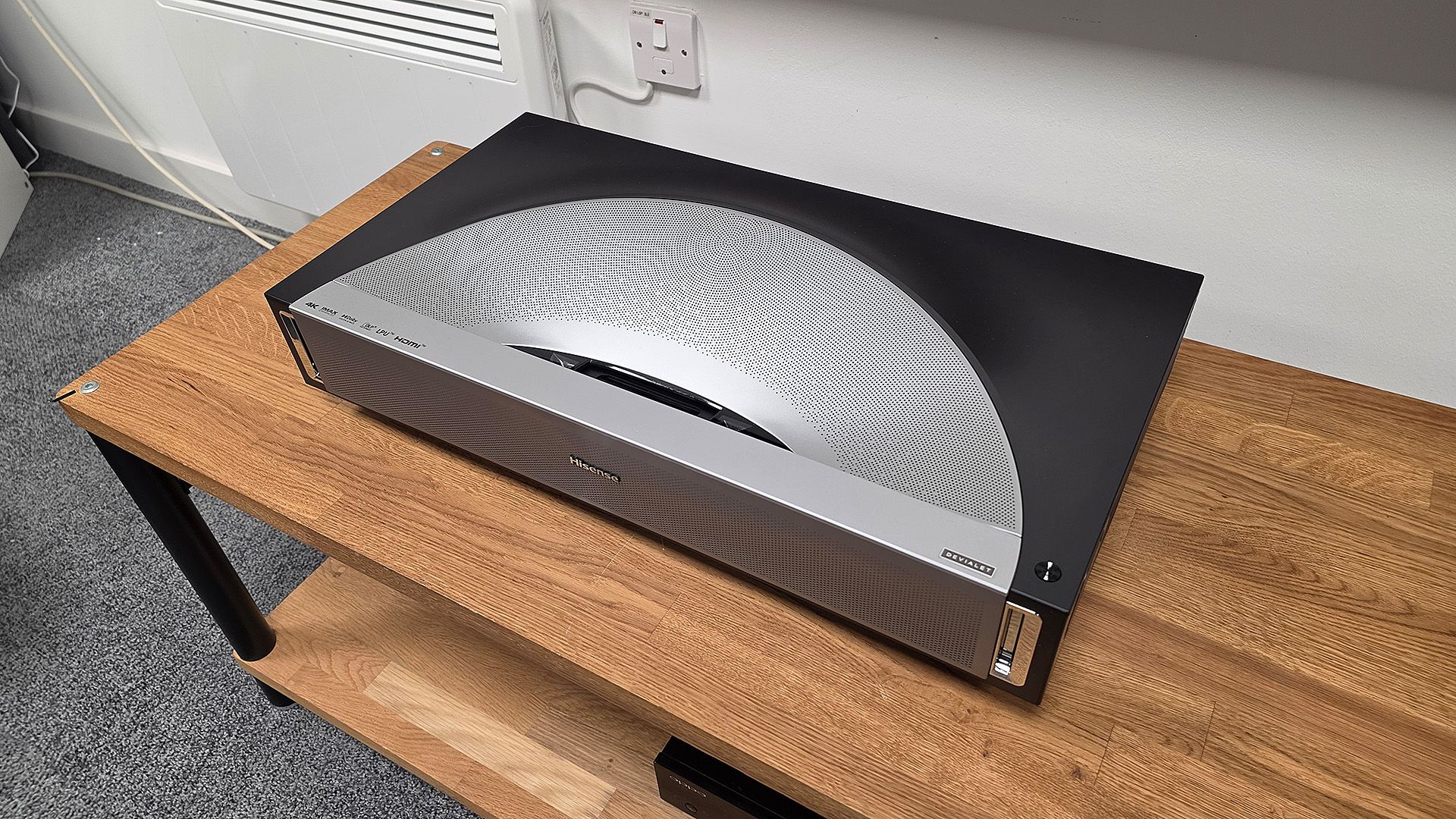
The 0.2:1 throw ratio puts a 100-120-inch image on the wall from less than a foot away. Pull the projector back to around 35in / 89cm and it reaches 200 inches, 50 inches more than the PX3 Pro. The angular metal body has a curved, amphitheatre-shaped grille on top that houses the speakers. One of the reviewers joked that it looks like Frank Gehry designed it.
Connections and gaming
There are four HDMI inputs: two HDMI 2.1 ports with ALLM and VRR, and two HDMI 2.0 ports. The eARC connection is on one of the HDMI 2.0 ports, so adding a soundbar or AV receiver doesn’t use up an HDMI 2.1 input. Hisense says the PX4 Pro is the first UST laser projector with FreeSync Premium certification. It can run 1080p/240Hz from a powerful enough PC, but at 4K it stops at 60Hz, so 4K/120Hz gaming isn’t possible. The smart platform is Vidaa OS rather than Google TV. It has Netflix, Disney+, Prime Video and Apple TV, and Freely in the UK. Shudder, Hidive and GeForce Now are not available.
How it performs
Out of the box, colours looked overbaked and motion smoothing made the picture look unnatural. What Hi-Fi? got the best results with Filmmaker Mode, the Warm 2 colour profile, Dynamic Tone Mapping switched on and motion set to Film. With those settings, blacks were deeper and still full of detail, highlights looked more natural, and the reviewers said the jerky motion of earlier Hisense USTs was gone. The problems were a visible rainbow effect, slight black crush, and a yellowish colour cast in dark scenes that the testers couldn’t fully correct. Upscaling was better than before but only average.
The Devialet-tuned audio gives a sense of height that most rival USTs lack. On heavy synth bass, though, it pushed too hard and rattled, and dialogue could sound harsh. Scores were 5 for picture, 4 for sound and 4 for features. The auto-correction setup still failed, so the reviewers had to adjust the image by hand.
The PX4 Pro sits between entry-level and flagship USTs. The five-star AWOL Vision Aetherion Max now costs £3199 / $3799. The four-star Hisense PT1 costs £1599 / $2199, and leftover PX3 Pro stock sells for around £1599. For film fans who can’t stretch to the AWOL, the PX4 Pro is the one to beat.