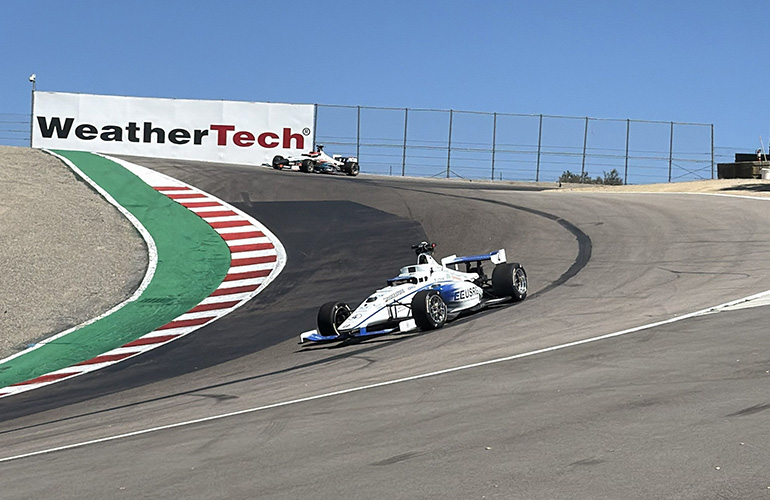
For years, the Indy Autonomous Challenge has proved that software can pass software at speed, but only on ovals. On September 3, 2026, at WeatherTech Raceway Laguna Seca in Monterey, California, that changed: for the first time in IAC history, autonomous racecars overtook one another on a road course. When the heats were done, Unimore Racing from the University of Modena and Reggio Emilia had won, beating Purdue AI Racing in the final.
The setting mattered. Since 2022 the IAC has held six passing competitions, all on ovals: Las Vegas Motor Speedway, Texas Motor Speedway and Indianapolis Motor Speedway. Laguna Seca is a different kind of test. Before the event, IAC technical lead Janam Sanghavi said AI drivers there must manage “changing corner geometries, braking zones, limited sightlines and rapid elevation changes.” Then there is the Corkscrew, the plunging left-right that has humbled human drivers for decades. According to Italian outlet HDmotori, Unimore’s car pulled off three overtakes through it, with no human intervention.
How the passing game worked
- Races were one-on-one heats in which the overtaking car had two laps to pass the leader.
- The teams then swapped positions, and the engine power limits went up for the next round.
- The AI drivers made every overtaking decision themselves. Human crews monitored the data and could trigger an emergency stop.
Losing the final still came with a consolation prize: Purdue’s car set an autonomous lap record of 1:27.731 at the track. That is a clear step on from the IAC’s July 24, 2025, time-trial event at Laguna Seca, where PoliMOVE-MSU won with a best lap of 01:29.792.
Same car, different brains
Nine university teams from North America, Europe and Asia took part. Each ran its own AI driver software on an AV-24 supplied by the IAC. Every car shares the same Dallara base design, Honda engine, Luminar sensors and NVIDIA GPU, so the event was essentially a software contest. The fastest code and the smartest racecraft won, not the biggest budget. Most teams are made up of Ph.D. and master’s students working on autonomous driving research.
The route to the grid was new too. Months before the race, teams had to qualify in a simulation event hosted by D-Space. They tested vehicle behavior, race strategy and overtaking performance in a digital twin of Laguna Seca. It was the first time IAC teams were required to qualify in a virtual testing environment before being allowed onto a physical track. That sim-first approach, familiar from self-driving car development, now doubles as a safety gate for 1-on-1 racing.
Why it matters beyond the racetrack
The IAC started in 2021 at the Indianapolis Motor Speedway and has increasingly become a talent pipeline. Alumni have gone on to found companies including Aidoptation, driveblocks and Autonoma AI. Overtaking on a twisting, blind, elevation-heavy circuit means predicting another machine’s line, judging braking zones and committing to a move. Those are exactly the skills that separate a lab demo from a road-ready autonomy stack. At Laguna Seca, a university team from Italy showed it can be done with the throttle wide open.