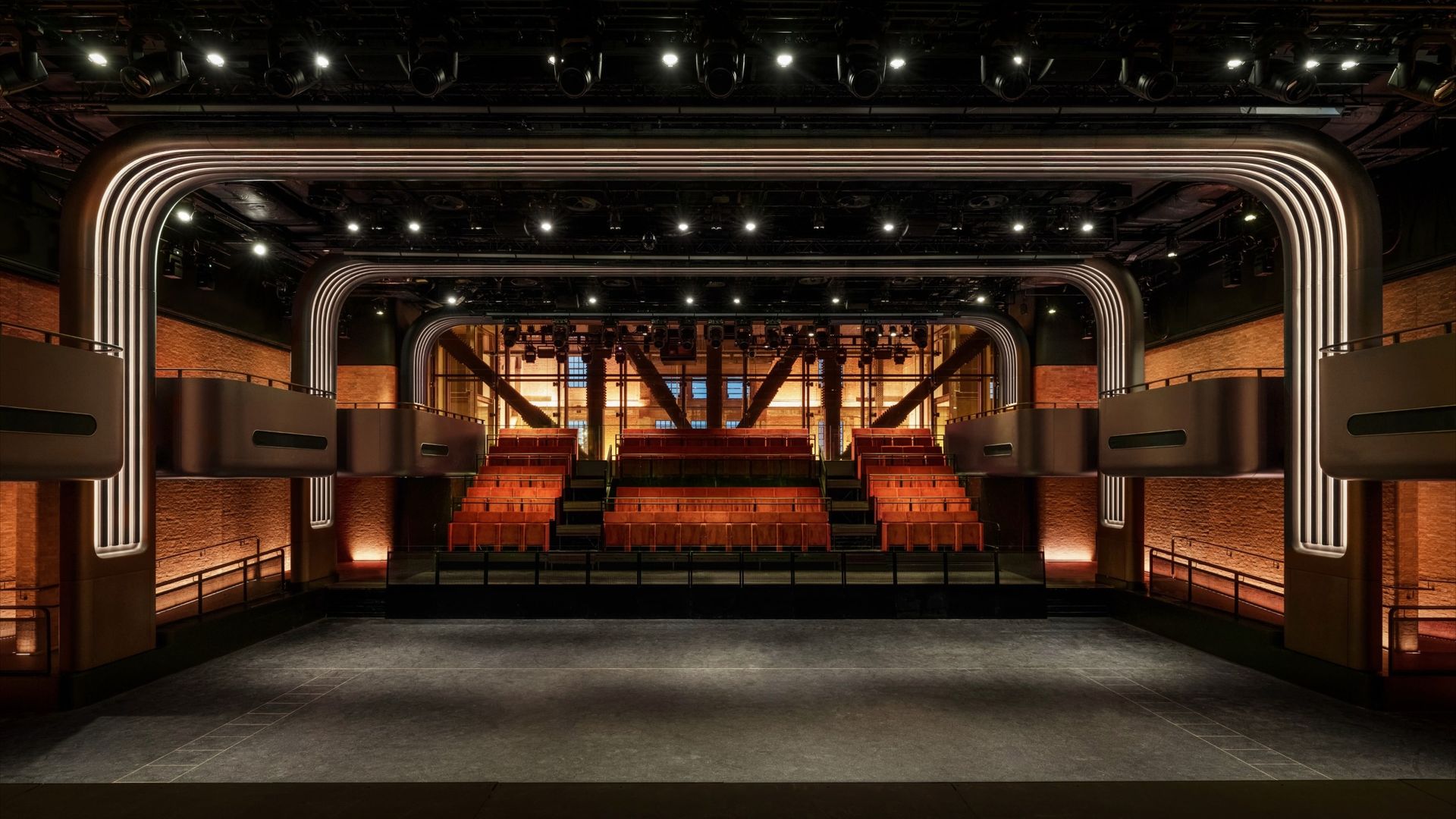
Apple Music is no longer only an app. On September 21, 2026, Apple announced Apple Music Hall, a 600-capacity live music venue inside London’s Battersea Power Station, the landmark that also houses Apple’s UK headquarters. Doors open on September 28, and no acts had been named when it was announced.
The difference from an ordinary club lies behind the stage. Apple describes the hall as a full production facility where every gig is also raw material for its streaming service. Performances will be recorded in Spatial Audio, filmed and livestreamed globally on Apple Music, so fans far from London can watch shows that happen only once.
What’s inside
- 600-capacity room, designed so that every seat feels close to the performer
- 38-foot-wide stage that can be reconfigured for traditional front-facing sets or in-the-round shows
- 48-speaker spatial sound system positioned all around the audience
- Two dedicated recording and mix studios, so every performance can be captured as a multitrack recording and mixed in Spatial Audio, live or after the fact
- Hardwired for 16 or more cameras feeding a purpose-built broadcast control room, with iPhone video capture running in parallel alongside traditional broadcast cameras
Apple sums up the pitch this way: an artist plays one intimate show and leaves with a finished Spatial Audio recording, a broadcast-ready mix and multicamera video. The venue is also meant as a single base where an artist can record a podcast, a radio show and a live concert. Alongside the hall, Apple said that all of Apple Music Radio’s London-based hosts and shows will now broadcast live from new radio studios in Battersea.
The room itself draws on the old power station. Apple lists heritage brickwork, fluted arches and bronze balconies reminiscent of the building’s historic oriel windows, plus a giant glass wall with a panoramic view of the concourse and the River Thames.
Not a rival to London’s clubs, says Apple
A tech giant opening a venue in a city whose nightlife has been struggling is a sensitive move, and Apple addressed it directly. “We’re not trying to be in the live business. We’re not trying to compete with anyone,” Oliver Schusser, Apple’s vice president of Apple Music, told BBC News. He added that the hall will be run “like a venue, with tickets and everything”, but that its purpose is to work with artists and broadcast the results on Apple Music, and that avoiding getting in anyone’s way is “one of the main reasons it’s a smaller space.”
Schusser’s argument is that streaming has left artists with little to do: “The music gets delivered by the labels, and then it’s a bunch of playlists.” A dedicated stage is meant to give fans a closer look at the people behind the albums.
This isn’t Apple’s first go at live music in London. The company used to run the annual iTunes Festival in venues such as The Roundhouse and Koko, with performances from Elton John, Lady Gaga and Adele among others. It became the Apple Music Festival in 2015 and was dropped in 2017.
Ticket and show announcements are handled through applemusichall.com and the @applemusichall accounts on Instagram and TikTok.
Earlier on GismoLand: Apple Music. The streaming service just got pricier for the first time in years.