A robot that works in the lab often grinds to a halt on a real jobsite. Kenrick Tjandra, Robotics Deployment Lead at Raise Robotics, is building a talk around that problem for RoboBusiness 2026, set for October 20–21, 2026 in Santa Clara, California. His session, “Closing the Capability Gap: A Leadership Framework for Scaling Field Robotics”, is listed for 1:15 p.m. ET on the first day of the show.
Tjandra’s starting point is blunt. “Most autonomous systems work in the lab and stall in the field,” he said, adding that an early-stage construction robot reaches a customer at roughly 80% of the capability the customer needs. The talk asks how a small engineering team closes that gap without spending its limited capacity on the wrong problems.
Who is Raise Robotics?
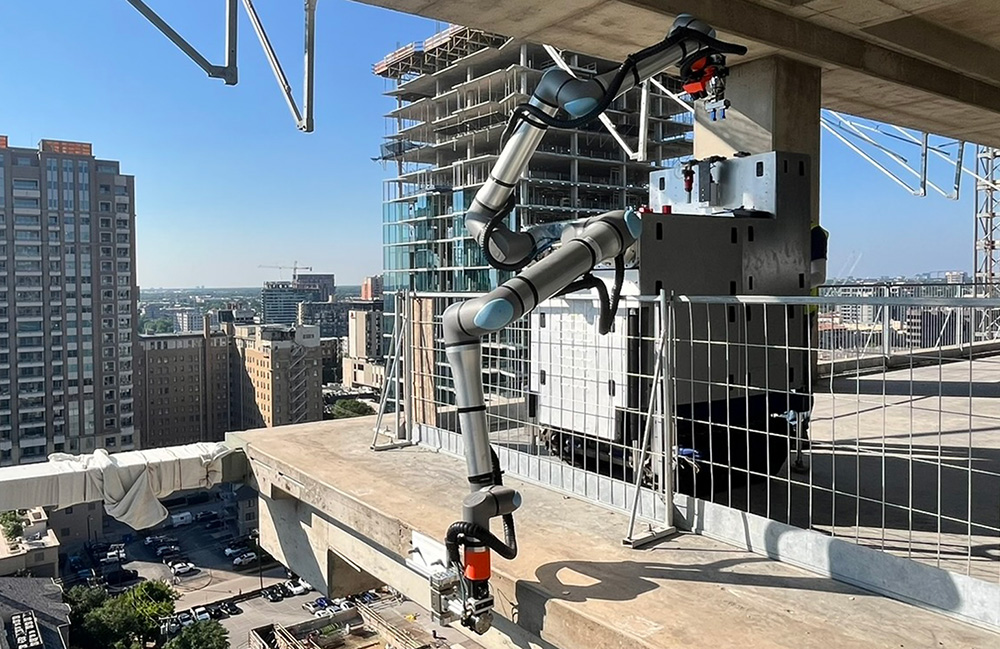
Raise Robotics is a San Francisco company that builds autonomous robots for installing building envelopes, the facade systems that wrap a structure. According to The Robot Report, the company has completed 10 projects across eight states, logging over 4,528 robot-hours with zero safety incidents. Its flagship machine is the Autonomous Mobile Fabricator (AMF), a work cell that combines a robotic arm, a compute stack and a universal tool interface. Raise lists working heights of up to 12′ on the ground vehicle, up to 30′ on a Genie GS Series scissor lift and up to 185′ on a Genie Z-60 FE boom lift. Layout marking, concrete drilling and as-built scanning are available now. Layout marking is rated at +/-3mm accuracy. Painting and coating and material movement are still in development.
What attendees are promised
Raise Robotics says attendees will leave with a decision rule for allocating engineering capacity and a vocabulary for two hidden failure modes. The talk is organized around three ideas:
- Sampling bias and margin stacking. Test results can make a robot look more reliable than it is in the field, and small error margins add up when operations are chained together or when on-floor precision budgets are tight.
- A resource taxonomy and a build-versus-workaround model. This helps decide which jobsite friction deserves a product fix and which can be handled by operators.
- A capability-envelope methodology. This anticipates where a system will break before a customer finds out.
The framework comes from Raise Robotics’ field record. A 2026 Project Production Institute paper co-authored by Tjandra and Rishabh Aggarwal draws on 10 commercial envelope-installation deployments with 9 U.S. general contractors in 8 states. The paper counts 4,528 robot-hours as of April 2026 and says about 13,500 worker-hours of leading-edge fall exposure were eliminated. It divides jobsite resources into ambient, premium and new categories. It then lays out a three-tier choice between ambient-compatibility investments, per-task investments and operational workarounds.
The speaker
Tjandra holds an M.S. in mechanical engineering from Carnegie Mellon. He wrote the peer-reviewed decision framework published by the Project Production Institute in 2026. He also developed an operator-training curriculum adopted by the International Union of Painters and Allied Trades across 100+ training centers in the U.S. and Canada, and he was an invited speaker at ICRA 2026 and Stanford.
Instead of a new robot, the talk offers a structured way to decide what to fix next and what to live with.