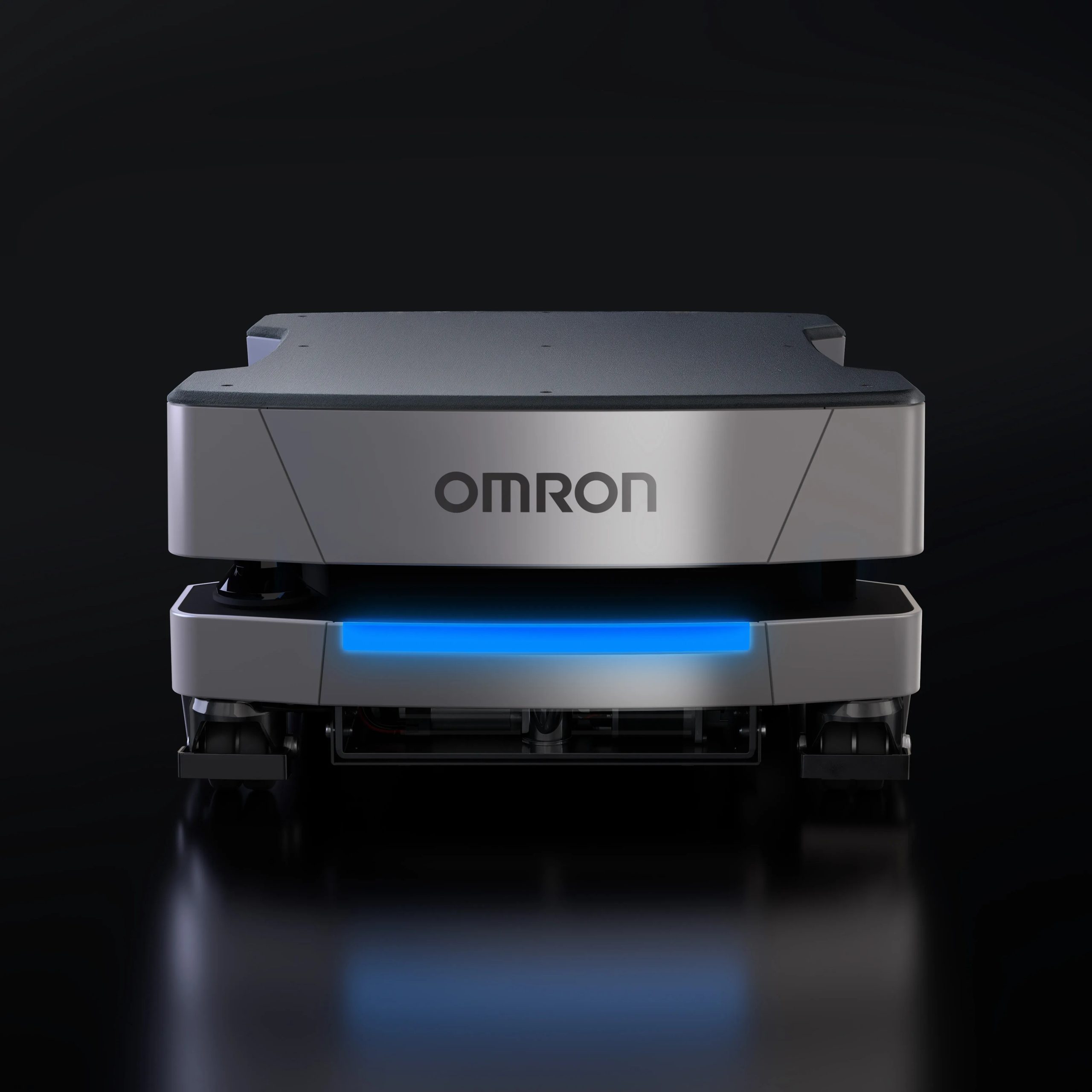
For years, buying an autonomous mobile robot came down to payload, speed and battery life. That is shifting, according to OMRON. In episode 264 of The Robot Report Podcast, published on October 2, 2026, Miguel Garcés Moreno, product marketing manager for EMEA at OMRON Industrial Automation Europe, discussed the company’s next-generation LD mobile robots. The episode’s central argument was that software, safety and fleet management now matter as much as the robot itself.
The hardware behind that argument is the all-new LD-150 and LD-300, the next generation of OMRON’s flagship LD Series. OMRON Robotics announced the pair on June 9, 2026, and demonstrated them at Automate 2026, held June 22–25 at McCormick Place in Chicago. On the booth, the robots handled material transport with topper solutions from partners ROEQ and Nord Modules. OMRON expects shipping to begin in Q4 2026.
Two payload classes, one platform
The model numbers give away the payload ratings. According to OMRON’s product page:
- LD-150: up to 150 kg, 500 W x 700 L x 320 H mm, 240° field of view (a rear field-of-view accessory is due in 2027)
- LD-300: up to 300 kg, 580 W x 800 L x 320 H mm, 360° field of view
- Both: maximum speed of 2.1 m/s, wireless inductive charging in 30 minutes or less, support for ramps with grades up to 5 degrees
OMRON says the robots can navigate aisles as narrow as 1 meter, so they fit into existing facilities without costly layout changes. The company also cites up to 2.5x higher payload capacity, up to 2.3x faster speeds and more than double the uptime ratio. These are OMRON’s own comparison figures, which is worth keeping in mind until independent deployments report back.
Safety as a baseline, not an add-on
Both models are certified to ISO 3691-4:2023, the safety standard for driverless industrial trucks. That lets people and robots share the floor without fenced-off lanes. Safety scanner coverage reaches up to 360 degrees. Unlike traditional AGVs or fixed-path systems, the AMRs adapt to changing layouts, people and workflows, so a reshuffled production line does not mean reprogramming a track.
The fleet is the product
This is where the podcast’s theme meets the spec sheet. The new LD Series runs on OMRON Fleet Operations Workspace Core (FLOW Core), the company’s fleet management software. FLOW Core coordinates AMR traffic, manages workflows and lets operators grow a fleet over time. Crucially, it is backward-compatible with legacy LD fleets, so the LD-150 and LD-300 can join existing LD Series and other OMRON mobile robot deployments rather than replacing them.
“The LD-150 and LD-300 give customers a more flexible AMR platform for heavier transport tasks in tighter spaces, with fast wireless charging and OMRON FLOW Core integration to simplify deployment and mixed-fleet management,” said Justin King, vice president of product management, business development and marketing at OMRON Robotics.
The pitch is aimed at manufacturers squeezed by labor constraints, changing layouts and rising throughput demands. OMRON’s bet is that the winning AMR is the one that slots into a mixed fleet, and the spec sheet reflects that. As of October 2026, OMRON had not published prices for either model.