When the field she wanted to work in didn’t exist yet, Maja Mataric simply helped invent it. In 2005, the USC professor of computer science, neuroscience, and pediatrics co-authored a paper that defined an entirely new discipline: socially assistive robotics. The idea was deceptively simple — build robots that help people not by lifting, fetching, or performing physical labor, but by talking, playing, and responding to emotions.
That work just earned her a 2025 Robotics Medal from MassRobotics, the Boston nonprofit’s award recognizing female researchers pushing the field forward. “Everyone was just smiling, and there was a great sense of love,” she recalls of the ceremony.
Mataric’s path to robots that care reads like a tour of the discipline’s history. Growing up in Belgrade, she was drawn to engineering by her father and to computer science by an aerospace-engineer uncle. After earning her bachelor’s in computer science at the University of Kansas in 1987, she landed at MIT’s AI Lab, where she worked under IEEE Life Fellow Rodney Brooks. There she built Toto, the first navigating behavior-based robot, which used sonar to map the lab and plan routes between rooms. By her PhD in 1994, she was coordinating teams of up to 20 robots executing tasks in tandem.
The pivot to assistive work came from an unlikely source: her daughter. When the child asked why her mother worked with robots, Mataric wanted a better answer than “I publish a lot of research papers.” Her goal became simple — “Mommy’s robots help people.”
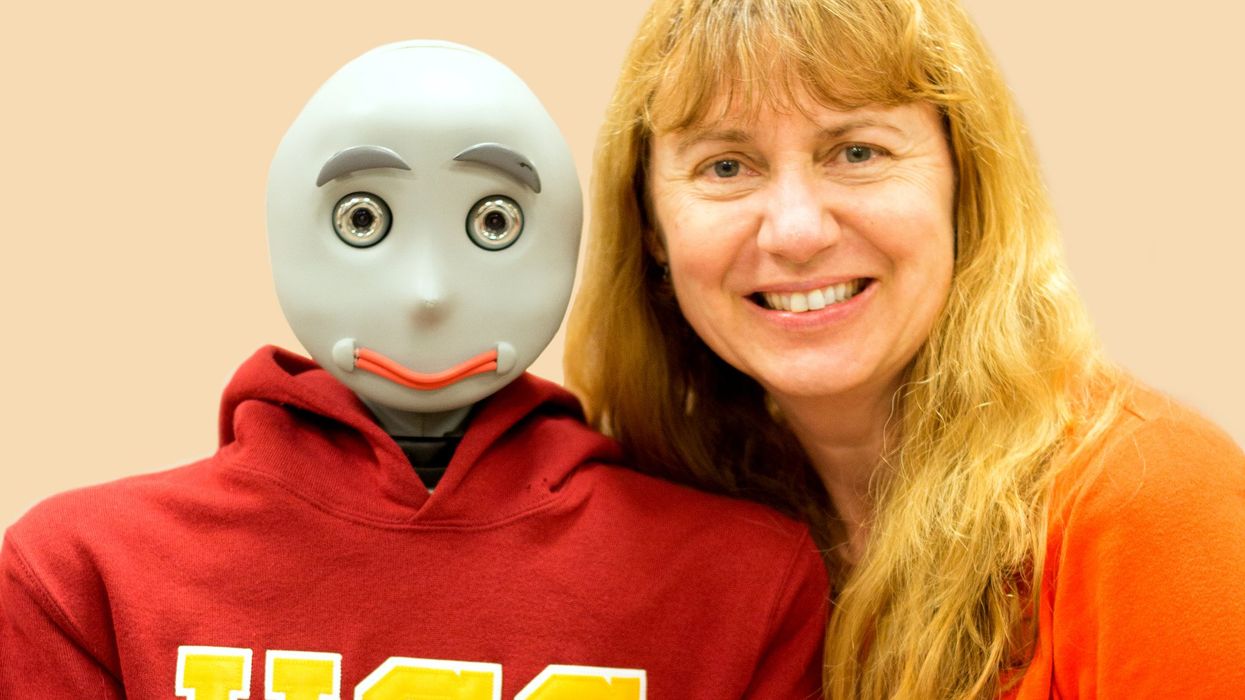
At USC’s Interaction Lab, that mission produced a small menagerie of social machines. Bandit stands 56 centimeters tall with a humanlike head, torso, and arms, a head that pans and tilts, two FireWire cameras for eyes, and a movable mouth and eyebrows for facial expressions, all mounted on a wheeled base. In studies with children on the autism spectrum, kids interacting with Bandit initiated play and imitated the robot — behaviors that were unusual for them. The robot also coached elderly users and stroke patients through seated aerobics and daily exercises.
Later came Kiwi, an owl-like helper, and Blossom, originally developed at Cornell and adapted by the lab to be cheaper and personalizable.
Blossom now sits at the center of Mataric’s most intriguing question. With large language model chatbots increasingly pitched as mental-health aids, she wanted to know whether a friendly physical robot did better. In a two-week study in USC dorms, students ran daily cognitive behavioral therapy exercises with either a chatbot or Blossom — both powered by the same LLM. The result: students working with the robot showed a significant improvement, while chatbot users did not.
That finding earned a 2024 grant from the U.S. National Institute of Mental Health for a six-week clinical trial, now underway. Its 120 student participants wear Fitbits and complete clinical distress assessments before and after sessions, while researchers study how Blossom’s movements, exercises, and feedback can adapt to each person.
“Plenty of what my team and I do today is still driven by curiosity,” she says, “but it is answering the question: How can we help someone live a better life?”