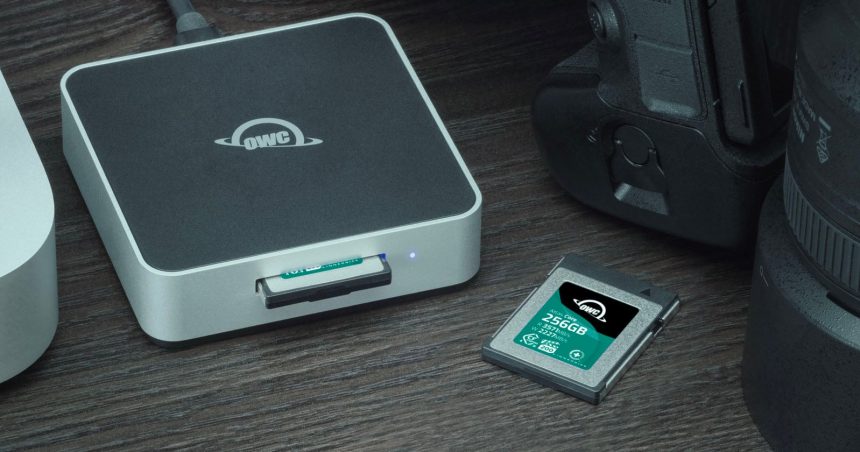
The global flash shortage has been quietly inflating the price of SSDs and memory cards, and photographers have been footing the bill. OWC’s response is the Atlas Core CFexpress 4.0 Type B 256GB — a card that aims to keep the speeds that matter while shaving off the cost of the headroom you probably never touch.
Announced on June 25, 2026, the Core sits at US$279.99, putting it in direct competition with Lexar’s Gold series, SanDisk’s Extreme Pro, Glyph’s Capture+ and Nextorage’s B3SE cards. For now it’s a one-size deal: 256GB is the only capacity in the Core line.
On paper, the numbers are far from entry-level. OWC rates the card at up to 3571MB/s read, 2227MB/s write and a 368MB/s sustained write, which pushes it past its own VPG200 certification. In practice that’s enough muscle for high-resolution RAW burst shooting, 4K video and up to 8K compressed video without dropping frames.
And here’s the clever bit of marketing logic: VPG 200 is realistically as fast as most CFexpress Type B mirrorless cameras need, even in their most demanding capture modes. The flagship, range-topping cards on the market can’t even run at full tilt inside current bodies. So why pay for speed your camera will never tap? That’s the gap OWC is targeting.
“Most photographers and creators don’t need the most expensive card on the planet,” said Larry O’Connor, OWC’s founder and CEO. “They need the card they can trust when the moment actually matters. Missed shots don’t care about marketing claims.” He framed the Core for the “real-world creator who wants professional confidence without paying for speed they’ll never fully use” — whether that’s a wedding, a client shoot, a travel vlog or a kid scoring the winning goal.
Compatibility covers the usual suspects: Canon R-series, Fujifilm GFX, Nikon Z and Panasonic S-series mirrorless cameras, plus Nikon DSLR shooters making the jump up from XQD.
Beyond raw throughput, the Core slots into OWC’s wider ecosystem. It works with the company’s Innergize software for card health monitoring and firmware updates, and it ships with a three-year warranty — a reassuring backstop for media you’re trusting with paid work.
It’s a sensible play. With memory pricing as volatile as it currently is, a card that trims the spec sheet exactly where cameras can’t keep up — and leaves the speed where it counts — feels less like a compromise and more like a correction. The Atlas Core is available now.