There’s a poetic symmetry to Martin Parr‘s last major project. The British photographer, who died in December at 73 after a long battle with cancer, spent part of 2025 photographing Lacock — a Wiltshire village he first shot in the 1980s, early in the career that would make him one of the most influential documentary photographers in history. It was here he sharpened the saturated, wry, unmistakably human style that brought him international acclaim.
Now the U.K.’s National Trust has turned that final commission into an exhibition. Lacock by Martin Parr opened at the Fox Talbot Museum at Lacock Abbey on Saturday, June 27, 2026, and runs through June 27, 2027. Neither Parr nor the Trust anticipated this would be his concluding body of work.
The location is anything but incidental. Lacock Abbey is widely regarded as the birthplace of photography: it was here that Henry Fox Talbot invented the calotype process in 1835. For Parr, returning four decades later to document the village, its people and its everyday rhythms meant ending his career where the medium itself began.
“Martin knew that modern photography began at Lacock, and it was important to him that this remarkable place should feature in his archive,” says Dr Andy Cochrane, Curator at Lacock. “What we did not foresee is that this project would end up being his last major commission. That it was focused on the place where photography began, poetically closes the circle.”
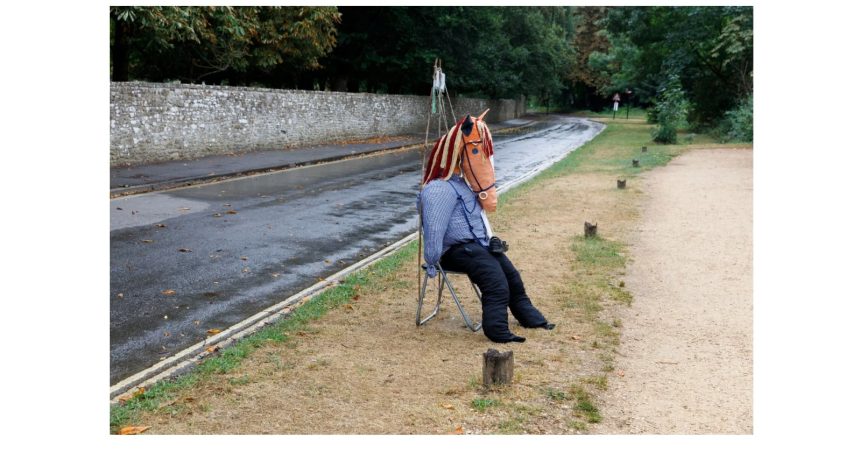
The show offers a rare, intimate look at Parr’s concluding year of work — a vivid portrait of contemporary Britain seen through a single Wiltshire village. Familiar Parr motifs run throughout, from the comic to the tender, including images like Scarecrow Festival, Lacock, Wiltshire, England, 2025.
Alongside the exhibition, the National Trust has published a book of the images. Its foreword comes from Susie Parr, the photographer’s widow, who reflects on what Lacock meant to her husband.
“It is such a bittersweet experience for me to look through these photos of Lacock taken by Martin over the past year. There are so many echoes from his work throughout his long career,” she says. “It’s a credit to Martin that he made this work, so full of the life he loved, when his health was failing so dramatically. What a great way to end such a distinguished career, back in the home of photography.”
The exhibition was developed in collaboration with Magnum Photos and the Martin Parr Foundation, with support from the National Trust’s photo printing partner CEWE. For anyone who has followed Parr’s wit-laced chronicle of British life, it’s both a farewell and a fitting full stop.