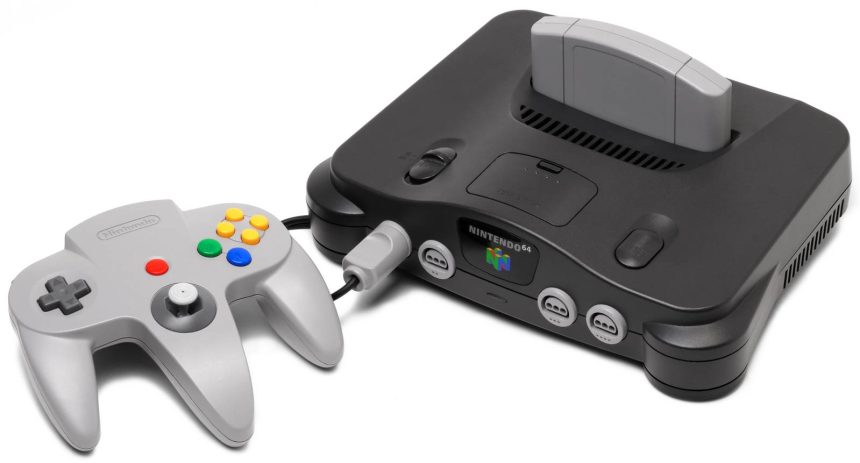
Thirty years on, it’s tempting to treat Mario Kart as an inevitability — the system-seller Nintendo can roll out with every console launch. But back in 1996, the formula was anything but proven. Mario Kart 64 is the game that took Super Mario Kart’s quirky SNES experiment and turned it into one of gaming’s most bankable franchises.
The numbers tell the story of a slow burn. The Nintendo 64 launched without a kart racer at all, leaning instead on Super Mario 64 and Pilotwings 64. Mario Kart 64 only arrived later — December 14, 1996 in Japan, February 10, 1997 in the United States, and June 24, 1997 in Europe — priced at US$69.95. Packed onto a 96-megabit (12 MB) cartridge, it gave the new hardware its second genuinely must-have reason to exist.
What changed everything was the leap to four players. The Nintendo 64’s four controller ports let four racers compete simultaneously — double the SNES original — provided you could stomach buying four of the system’s famously polarizing three-pronged controllers. That party-first focus reshaped how the series played, and how it managed competition.
Enter the blue shell. Mario Kart 64 codified the dynamic difficulty — affectionately or bitterly known as rubber banding — that still defines the franchise. Build a commanding lead and the game starts working against you; trail the pack and you’re handed weapons to claw your way back. The blue shell remains divisive precisely because it homes in on the leader alone, raining down vengeance from the skies. Overpowered? Absolutely. But it kept every race feeling tight, which is exactly what a party game needs.
The roster got a personality transplant, too. Koopa Troopa and Donkey Kong Jr. were retired in favor of Wario and Donkey Kong, rounding out a lineup of Mario, Luigi, Princess Peach, Toad, Yoshi, Donkey Kong, Wario, and Bowser. The new faces brought standout courses: Donkey Kong’s jungle track with its ferry, and Wario’s Stadium, with its hilly indoor terrain and a notorious glitch shortcut that could shave entire laps off your time.
Then there’s the drift. Super Mario Kart punished overly long slides with a spin-out, but Mario Kart 64 rewarded power slides outright. Hold a slide and the tires start smoking; steer against the drift and the smoke shifts color, then to a faint red — release at that moment for a burst of speed. The technique, later dubbed snaking, turned even straightaways into a skill test.
The legacy is hard to overstate. Mario Kart 8 alone has sold nearly 80 million copies across Wii U and the original Switch. Without this N64 entry proving the concept had legs, it’s safe to say Mario Kart World wouldn’t be headlining the Switch 2 today.
If you’ve never raced it — or it’s simply been a while — Mario Kart 64 lives on via the Nintendo Switch Online Expansion Pack, having previously appeared on the Wii and Wii U Virtual Console and Nintendo Classics. It’s still worth a few laps.