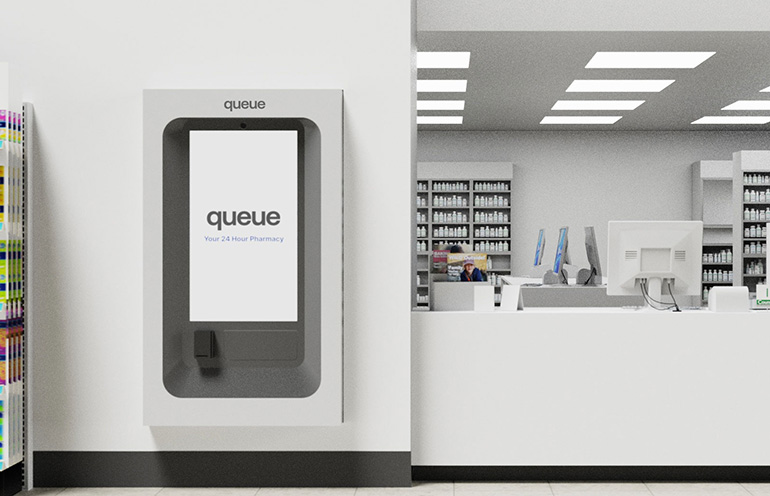
Imagine walking up to a kiosk, scanning your prescription, and watching a machine pour, count, label and double-check your medication — all without a human pharmacist standing behind the counter. That’s the pitch behind the Queue Unit, an autonomous pharmacy system that emerged from stealth on June 24, 2026, in Palo Alto, California.
Queue isn’t selling a vending machine for vitamins. The company is building a fully automated pharmacy designed to take in sealed wholesale bottles and spit out filled, verified prescriptions on the other side. The whole point is to remove the on-site pharmacist as a bottleneck — the machine fills and verifies orders by itself, on location.
That last word matters. Plenty of mail-order operations already automate the filling stage in centralized warehouses, but they ship your meds to you days later. Queue’s approach is local: the unit does the work where you are, whether that’s a hospital corridor, a retail storefront, or a clinic in a community that has no nearby pharmacy at all. Access, not novelty, is the stated mission.
Here’s what we can confirm about the hardware so far:
- 250 SKUs — the number of distinct medication products a single Queue Unit can stock and dispense.
- Fills and verifies on-site — no pharmacist required at the point of dispensing.
- Sealed bottle to sealed prescription — wholesale stock goes in, finished prescriptions come out.
The verification piece is the interesting part. Counting pills is the easy problem; the hard one is confirming that the right drug, in the right dose, ended up in the right bottle for the right patient — the safety check that licensing rules normally reserve for a trained human. Queue is betting it can automate that step reliably enough to satisfy both regulators and patients, which is a far taller order than simply moving capsules from A to B.
The company announced the launch alongside fresh funding to scale the system, though it hasn’t publicly disclosed how much it raised or who backed the round. What’s clear is the target: underserved communities where pharmacy deserts force people to drive hours for routine refills, and high-volume settings like hospitals where pharmacy staff are stretched thin.
Queue arrives at a moment when pharmacy automation is heating up across the industry, but most rivals still keep a licensed pharmacist in the loop. A genuinely autonomous unit that fills and verifies without one would be a meaningful shift — assuming the regulatory framework keeps pace. With a working system already demonstrated rather than rendered in slides, Queue has at least cleared the first hurdle of credibility. The next, and harder, test is whether 250 SKUs in a box can earn the trust we currently place in the person behind the counter.