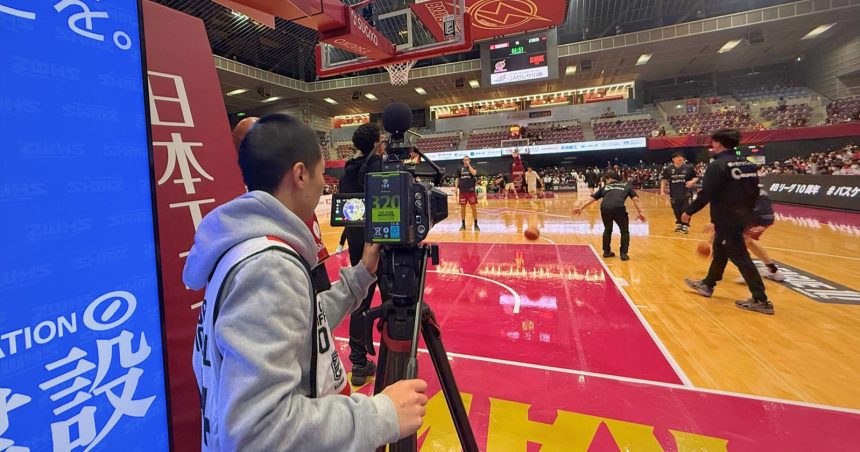
Filmmakers in Japan just gave home viewers a front-row perspective on professional basketball, using Blackmagic Design’s Ursa Cine Immersive to capture a live game in a way that flat broadcast cameras simply can’t match. It’s the same camera that recently documented a Chinese rocket launch — proof that the appeal of true stereoscopic capture stretches from the launchpad to the hardwood.
The Ursa Cine Immersive is built specifically for immersive content, and its headline feature is a pair of dual 8K sensors that deliver 8160 x 7200 resolution per eye. Crucially, the two sensors run with pixel-level synchronization, so the left and right views line up perfectly — no ghosting, no drifting, no headache-inducing mismatch when you slip on a headset. The sensors also pull in 16 stops of dynamic range, which matters enormously in a venue like an arena, where blindingly lit courts sit against deep shadow in the stands.
For fast-moving sports, frame rate is everything, and here the camera offers plenty of headroom. It supports project frame rates of 23.98, 24, 25, 29.97, 30, 50, 59.94, 60 and 90 fps, giving cinematographers the ability to lock onto the fluid, real-time cadence that makes a dunk or a fast break feel like you’re standing on the sidelines.
Shooting immersive footage at these resolutions generates an enormous amount of data, so Blackmagic built the storage right in. The camera ships with 8TB of removable high-performance media, meaning operators aren’t scrambling to swap cards mid-quarter or worrying that a lengthy game will outrun their capacity.
What makes the basketball application interesting isn’t just the spec sheet — it’s the intent. Traditional sports broadcasts cut between dozens of fixed cameras, guiding your eye wherever the director decides. Immersive capture flips that logic: it hands the viewer a fixed vantage point and lets them look wherever they want, whether that’s tracking the ball, watching an off-ball screen develop, or simply soaking in the crowd. For a sport built on spatial awareness and split-second geometry, that’s a compelling shift.
None of this comes cheap. The Ursa Cine Immersive carries a price of US$29,995, firmly placing it in professional production territory rather than the hands of hobbyists. Deliveries began in late Q1 2025, and the camera is now available.
The bigger takeaway is that immersive cinema hardware is quietly maturing from novelty into a genuine production tool. Rocket launches and pro basketball are wildly different subjects, yet both benefit from the same thing: a camera that captures a place so faithfully you feel like you’re actually there. As more headsets reach living rooms, expect the list of events shot this way to keep growing — and the courtside seat may increasingly be a virtual one.