Somewhere in the 35-kilometer-wide strip of land that straddles Ukraine’s front line — the so-called kill zone — an 800-kilogram machine is stalking through the dark. It’s called the Zmyi, Ukrainian for “snake,” and it’s one of the reasons that anything human-shaped near the front now has, in the words of defense analyst Marc C. Lange, “between seconds to a low amount of minutes” before it’s turned to dust.
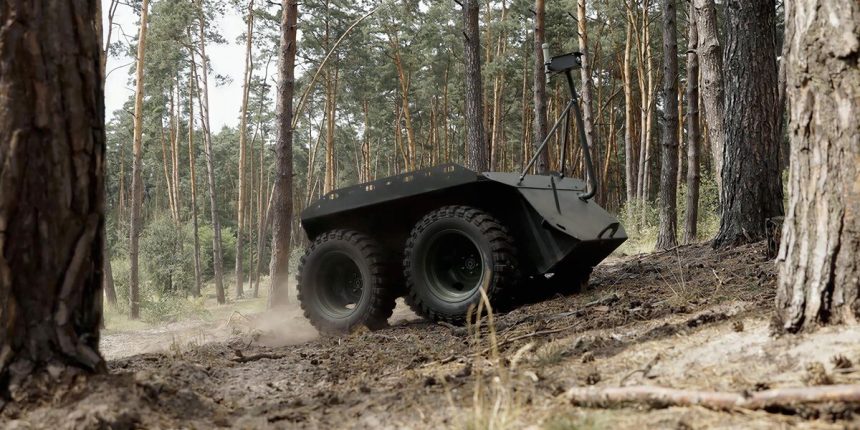
Built by RoverTech, the Zmyi is a remotely controlled ground robot measuring 2.15 by 1.5 meters, riding on wheels 75 centimeters in diameter. It comes in flavors for demining, logistics, firefighting, hauling a machine gun, or lobbing grenades. What sets it apart, according to co-founder and CEO Borys Drozhak, is survivability: engineered to run nearly silent and radiate as little heat as possible, it slips past Russian surveillance drones. The result is startling. Where a typical uncrewed ground vehicle (UGV) lasts about seven missions, the Zmyi averages 57 missions before it’s destroyed — and it can limp home even with two wheels shot out.
Drozhak’s backstory is now a familiar one in Ukraine’s defense scene. A software engineer, he left a quiet life in Ireland after the 2022 invasion and teamed up with mining engineer Vasyl Korenovskyi to build robots for the war’s deadliest jobs. Their first product, the Zmyi de-miner, rolled out in 2023. Earlier this year, one of RoverTech’s assault UGVs helped force a group of Russian soldiers to surrender — with no Ukrainian troops present.
This is the logic driving the whole category. A robotic vehicle costs a few tens of thousands of dollars against millions for a tank, and front-line workshops can tweak them on the fly. In April, President Volodymyr Zelenskyy ordered the procurement of 50,000 UGVs by the end of 2026 — more than triple the 2025 haul and a vast jump from the roughly 2,000 bought in 2024.
Rivals are pushing the concept further. DevDroid’s Oleg Fedoryshyn says his ground robots can be driven from as far as 100 kilometers away over Starlink, LTE, or mesh military radio, carry strike drones, act as communication relays, and lie in ambush for up to a week without a battery charge. “A guy with a machine gun is always the first target for the enemy,” he notes.
The catch is fragility. Analyst Samuel Bendett of CNA argues UGVs haven’t reshaped warfare the way aerial drones have — rough terrain blocks radio signals, Starlink stutters near trees and buildings, and Russia is racing to jam it. As drone autonomy outpaces ground-robot autonomy, Lange warns, UGVs may face “a barrage of strikes” too heavy to endure.
Even so, Drozhak dreams bigger: a fully automated front line of sensors and servicing robots. RoverTech’s Tarantula system, which fuses acoustic and visual sensors with AI to spot incoming killer drones, is his first step. “At some point,” he says, “we could have only robots in the kill zone.”