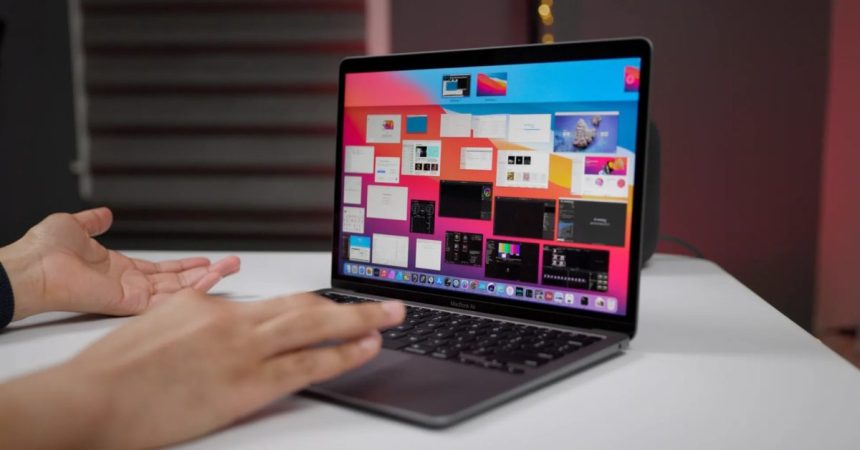
There’s a familiar ritual in IT departments everywhere. A laptop hits the four-year mark, someone flags it as end-of-lease, and it gets shuffled off to recycling before it can clog up a support queue. For years, Apple laptops followed that script faithfully. Then the MacBook Air (M1, 2020) came along and quietly tore up the rulebook.
The machine that launched Apple’s silicon era on November 17, 2020 has aged with unusual grace. Where older Intel-based MacBooks felt sluggish and disposable by year four, the M1 Air is still genuinely usable — fast enough for daily work, cool enough to run fanless, and efficient enough to shrug off the passage of time. In a market where new Macs keep drifting upward in price, that longevity has real financial weight.
Part of the reason is the chip itself. The M1 pairs an 8-core CPU — four performance cores and four efficiency cores — with a 7- or 8-core GPU and a 16-core Neural Engine. That combination was overkill for a thin-and-light laptop in 2020, and that headroom is exactly what keeps it relevant today. Configurations shipped with up to 8GB or 16GB of unified memory and up to 2TB of SSD storage.
The rest of the package holds up too:
- Display: 13.3-inch LED-backlit Retina panel at 2560×1600 with True Tone
- Camera: 720p FaceTime
- Input: Magic Keyboard with scissor mechanism, Force Touch trackpad, Touch ID
- Weight: 2.8 pounds (1.29 kg)
None of that is bleeding-edge in 2026, but that’s rather the point. A laptop doesn’t have to be cutting-edge to be useful — it has to be good enough for long enough. The M1 Air cleared that bar and kept going.
Its origin story helps explain the value equation. The base model — 7-core GPU, 8GB of unified memory, 256GB SSD — launched at $999 (£999 in the UK). For a machine that’s still comfortably serviceable years later, that’s arguably one of the strongest price-to-lifespan ratios Apple has ever offered.
Officially, the M1 Air is history. Apple discontinued it on March 4, 2024, pulling it from the lineup as newer silicon took over. But it didn’t vanish entirely: Walmart struck a partnership with Apple to keep selling the 256GB M1 MacBook Air even after Apple’s own retail channels moved on — a rare afterlife for a discontinued Mac, and further proof that demand for the little machine hasn’t dried up.
For anyone managing fleets of Apple hardware, the lesson lands hard. The end-of-lease reflex — recycle it, forget it — doesn’t automatically apply anymore. The M1 Air proved a well-made laptop can earn its keep well past the point where its predecessors were headed for the scrap heap.