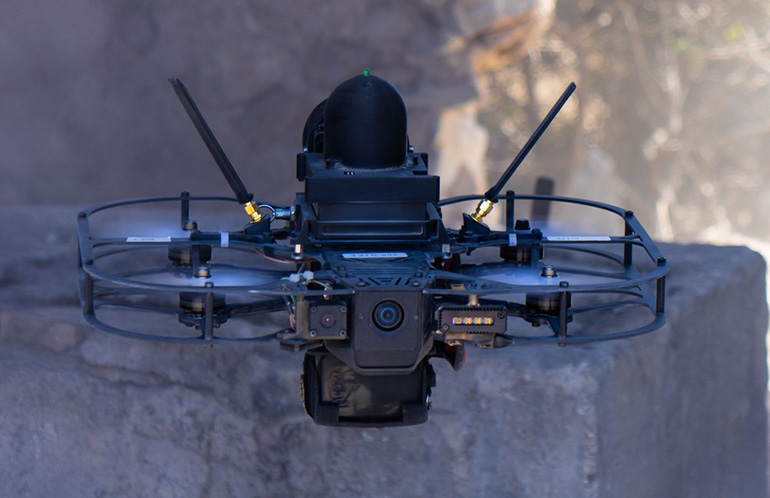
Guiding a drone through a chaotic, obstacle-strewn environment is one of the hardest jobs in robotics — and one of the most exhausting for the humans holding the controller. XTEND, an AI-powered robotics and software company, has just locked down intellectual property aimed squarely at that problem.
On July 2, 2026 (following an announcement on June 30), XTEND was granted U.S. Patent No. 12,222,735, covering technology that lets an unmanned aerial vehicle autonomously navigate toward an operator-designated objective in dynamic, unpredictable surroundings. Corresponding patent protection was also granted in Israel.
The core idea is deceptively simple in description and fiendishly complex in execution: a user marks a destination, and the vehicle continuously steers itself toward that point — independent of the surrounding environment. Rather than requiring the operator to manually thread the machine past every wall, doorway or moving obstacle, the system keeps its eyes on the prize and adapts its flight path on the fly.
That distinction matters. Plenty of drones can hold a GPS waypoint in open sky. What XTEND is protecting is the ability to keep making progress toward a marked target even as the world around the aircraft changes — the kind of messy, cluttered scenario where conventional autonomy tends to stall or demand constant human babysitting.
The payoff, according to XTEND, is threefold:
- Reduced operator workload — the human sets the goal, and the machine handles the moment-to-moment navigation.
- Reliable mission execution — the vehicle maintains momentum toward its objective rather than freezing when conditions shift.
- Adaptability in complex environments — navigation adjusts continuously without losing the thread of the assigned task.
This isn’t a standalone gadget you can add to a cart. The patented technology is foundational plumbing baked into XTEND’s XOS operating system, the software layer that runs across the company’s robotic platforms. Think of it less as a product launch and more as XTEND reinforcing the moat around how its machines think.
The company frames the grant as an expansion of a growing portfolio built around three pillars: autonomous navigation, operator assistance, and mission execution. Each of those touches the same underlying ambition — shifting the cognitive load from the person on the ground to the intelligence in the air.
For an industry racing toward genuine hands-off operation, patents like this are the quiet groundwork. The flashy demos come later; the ownership of the ideas that make them possible comes first. With No. 12,222,735 now in hand, XTEND has staked a formal claim on a piece of that autonomous future.