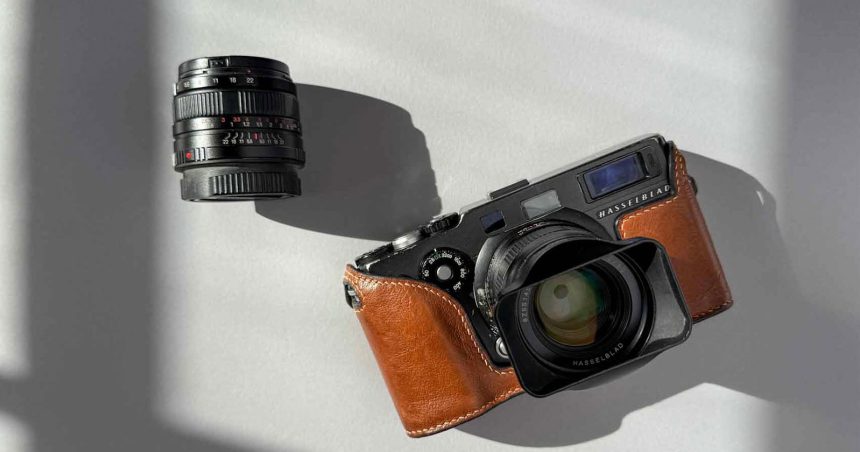
Bringing a Hasselblad XPan to a sports shoot sounds like a contradiction, and that’s exactly why photographer Tom Kluyver did it. His editorial series, shot at London’s Barbican at sunrise, set out to answer a deceptively simple question: can a deliberate, slow panoramic film camera capture the energy of running in only a handful of frames?
The XPan is not built for speed. It offers no autofocus, no instant feedback, and — in Kluyver’s case — a single loaded roll. That’s the opposite of how sports photography usually works, where burst rates and endless frames rule. Here, every exposure had to earn its place. The photographer described metering for the bright sunlight and letting the shadows fall away, producing a cinematic look with deep shadow and highlights that retain detail. The XPan meters from the center of the frame rather than as a tight spot reading, which makes high-contrast conditions especially tricky.
A minimalist kit
Kluyver kept the setup lean: one body, two lenses, one main film stock.
- Hasselblad XPan 45mm f/4 — the widest option for context-driven frames, giving a natural sense of space
- 90mm f/4 — for detail and separation, isolating the subject and cleaning up the background even at modest apertures
- Kodak Portra 400 — the main stock, with a faster roll carried as backup
The panoramic format did most of the storytelling. Instead of freezing motion literally, Kluyver leaned on gesture, silhouette, posture and the rhythm between images, treating the sequence like a set of film stills rather than isolated portraits. The Barbican’s hard concrete geometry supplied the visual tension he was after: soft human movement against sharp architectural lines.
The morning shoot
The 5 a.m. alarm and a sunrise call time set the tone. Working with sports model Maud, Kluyver scouted the complex on arrival to learn how early light moved between the tall structures, hunting for narrow pools of sun. He placed his subject in the light and kept the surroundings in shadow, using that contrast to strip out distractions and make her stand out.
The camera was slow, and so was he. Without autofocus or instant review, many movements had to be repeated until the leg position and timing lined up. In total, twenty frames were shot. A few became the backbone of the series: a wide contextual frame with a sharp shadow on the far wall, a mid-distance shot using a curved track to lead the eye through the wide format, and a close-up where reaching for glasses added structure — a smart trick, since the XPan’s elongated frame can feel empty on tight compositions.
The honest takeaway? Kluyver admits he stuck too closely to his plan and wishes he’d explored motion blur. But that’s the point of a portfolio shoot — an editorial series isn’t about one perfect moment, but a small narrative built from images that all serve the same idea.