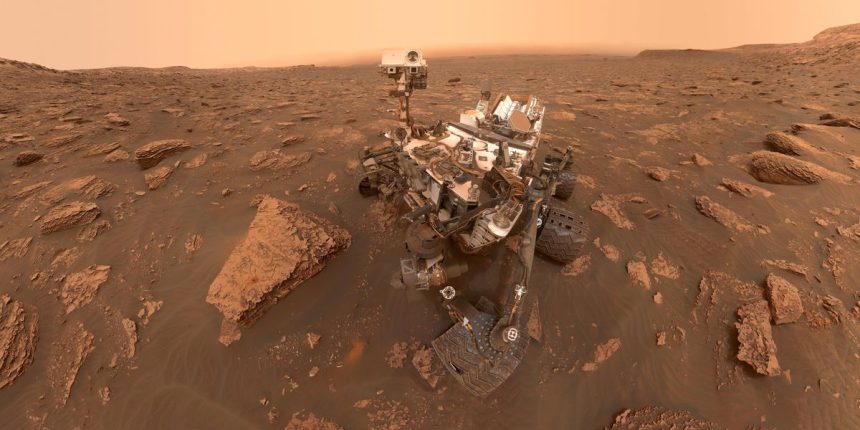
Some gadgets get retired after a couple of years. NASA’s Curiosity rover has been chugging along on Mars for 13 years, 337 days as of July 9, 2026 — that’s 4,949 sols, a Martian day being about 24 hours and 40 minutes. In that time the Mars Science Laboratory has covered nearly 37 kilometers, drilled 42 rocks, and shot close to 763,000 photos. And the only maintenance option available to the engineers at NASA’s Jet Propulsion Laboratory is a very carefully written software update sent across interplanetary distances.
Alexandra Holloway, assistant team chief for engineering operations, put it bluntly to IEEE Spectrum: no car, refrigerator or embedded system comes close to this kind of longevity. And the machine is arguably getting more capable, not less.
The great memory rescue. The most impressive save reads like a survival thriller. Curiosity carries two computers, A and B. It landed running A, then swapped to B on Sol 200 after a NAND memory glitch. Years later, B booted but couldn’t mount its drive partition — something never seen before. The team fell back to A, whose degraded memory offered only two gigabytes of usable storage instead of four, painstakingly ferried data across, and then A began failing exactly as it had on Sol 200, as if its memory were coming unsoldered.
The fix was elegant to the point of audacity. Curiosity keeps four copies of its flight software — two current, two older — in tiny 32-megabyte memory banks. Engineers jettisoned the two old copies and repurposed that 64-megabyte NOR memory as computer A’s file system. The release was named “R-Hope” because they hoped it would work. It did. Computer A now runs on less than one percent of its original memory, yet the rover can still drive, manage data and, in theory, do science — just slower and smaller.
What’s wearing out. The biggest hardware headache is wheel damage. Innocent-looking pebbles turned out to be the razor-sharp tips of buried boulders, shredding the front wheels — so the team now drives backwards. Actuator cycles are treated as a consumable, which is why selfies have become rare. The real limiter is power: Curiosity’s Multi-Mission Radioisotope Thermoelectric Generator, packing 10.6 pounds of plutonium-238, steadily loses output as it ages.
To stretch every watt, operators now power down the computers whenever tasks finish early, and run parallel activities — driving or using the arm while talking to an orbiter. Compared with newer rovers, Curiosity’s RAD 750 processor is a power hog; Perseverance, which uses the same RAD 750 and memory, adds a dedicated visual-odometry processor for autonomous driving and has already out-driven Curiosity.
The RTG is projected to start dialing back science output in the sixth extended mission, but Holloway says the rover will be fine through 2035 and possibly beyond. The bottleneck, she reckons, may end up being budget rather than hardware. For a robot built to last two years, that’s a remarkable problem to have.