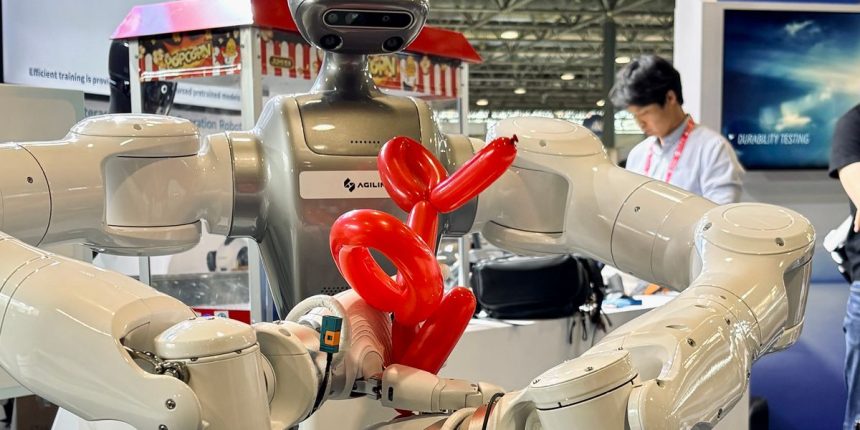
At ICRA 2026 in Vienna this June, one demo quietly stole the show — and it involved balloon animals. Two robotic hands twisted a long balloon into loops, bends and joints, slowly shaping a balloon dog without popping it. Playful? Sure. But among roboticists, balloon twisting is notoriously brutal: the object is light, slippery, endlessly deformable and painfully sensitive to force. Every twist changes its geometry and internal pressure, turning a party trick into a continuously shifting physics problem.
That demo was the warm-up act for AGILINK’s real headline: the OmniHand 3 Ultra-M, a dexterous robotic hand built around one idea — that in robotics, the hardest problems often begin the moment contact happens.
Motion versus contact
AGILINK splits the challenge into two capabilities. Motion intelligence handles the long sequence of actions — a balloon dog isn’t one grasp but an ordered chain where a tiny early error can wreck the final shape. Contact intelligence is subtler: continuously regulating force, adjusting where the fingers touch, and staying inside that narrow zone between the balloon slipping free and bursting. To teach it, the company recorded professional balloon artists, mapped their movements onto the hands, then fed in real-time human corrections — capturing not just how success looks, but how experts recover when things start going wrong.
Hardware built to feel
Roughly the size of an adult human hand and weighing 630g, the Ultra-M packs 20 active degrees of freedom into a human-scale form factor. Its defining trait is a fully direct-drive architecture across the entire system, designed for faster, more transparent force regulation and higher force-control bandwidth — because when contact conditions change, responsiveness matters as much as sensing.
And the sensing is dense. Each fingertip carries a miniature vision-based tactile sensor, while tactile sensing points spread across the palm. The system estimates pressure distribution, shear forces, local deformation and slip tendencies — the kind of interaction dynamics that stay invisible to conventional position-based control.
- Deformation precision of 0.08 mm across a 0–30 N range — like feeling a sheet of paper rest on a fingertip
According to AGILINK, the hand runs at 40–45 °C under continuous load with no throttling, and has been validated to 500k cycles.
Why it matters beyond balloons
The stakes reach far past party tricks. Cable insertion, garment handling, flexible packaging, delicate assembly, connector mating, tool use, everyday household manipulation — these tasks resist automation not because robots can’t reach the right spot, but because holding a stable grip after contact begins is extraordinarily hard.
For decades, robotics won by engineering away uncertainty in structured factories. The real world doesn’t cooperate: objects shift, materials deform, friction changes. Seen through that lens, the balloon dog was never really about the balloon. As motion generation matures, a growing slice of research is pivoting toward interaction itself — and for robots stepping into unpredictable environments, managing contact may soon matter as much as motion.