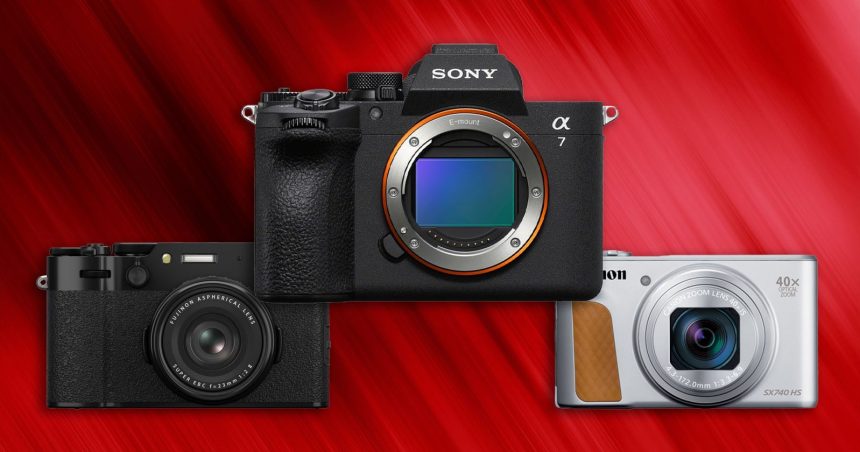
There’s a strange gravity in the camera market right now, and it’s pulling shoppers straight toward gear that shipped years ago. At Japanese retailer Map Camera, the latest sales tally is dominated by Sony’s mirrorless heavyweights — but the two most fascinating names on the list are a pair of aging Canon point-and-shoots that simply won’t leave.
Start at the top. The Sony a7 V has reclaimed first place after a one-month detour. In May it finally surrendered the crown to the Fujifilm X100VI, which — more than two years after launch — is still coveted and still routinely sold out. This time around the X100VI slipped to third, while the a7 V opened a “significant lead” over the runner-up, the new Sony a7R VI.
The a7 V has been Map Camera’s best-selling new digital camera every single month since its December release, and its return to the summit was swift. The a7R VI, a high-resolution model that launched in Japan on June 5, drew plenty of preorders but couldn’t unseat its more affordable sibling. That a pricier, resolution-focused body landed second at all says a lot about the appeal of Sony’s high-res line.
Sharing fourth place are the Sony a7C II and Fujifilm X-M5. The rest of the top ten is where things get interesting:
- Canon PowerShot SX740 HS
- Sony a6700
- Canon PowerShot G7X Mark III
- Fujifilm X-E5
- Ricoh GR IV
The GR IV would almost certainly have placed higher were it not for ongoing supply constraints. But the real curiosity is the Canon duo. The SX740 HS arrived in 2018 with a 40x optical zoom, a genuine pocket superzoom. The G7X Mark III followed just a year later. Seeing two cameras of that vintage still charting month after month is a loud testament to the compact-camera revival.
Demand, predictably, has outpaced supply. On B&H, both Canon models are sold out in every color. The retailer suggests the SX740 HS could return in three to five weeks, while there’s no timeline at all for the G7X Mark III.
What makes this more than a nostalgia footnote is Canon’s own caution. The company recently told PetaPixel it is approaching new compact development carefully, unsure whether this is genuine, sustained growth or a trend that fizzles once the hype cools. So far the data isn’t backing the skeptics: CIPA figures show the compact-camera surge is still climbing in 2026.
For now, buyers keep voting with their wallets — for cameras that some manufacturers seem almost reluctant to make. It’s a rare moment where the used-and-old market is dictating the conversation, and everyone is watching how the big names respond.