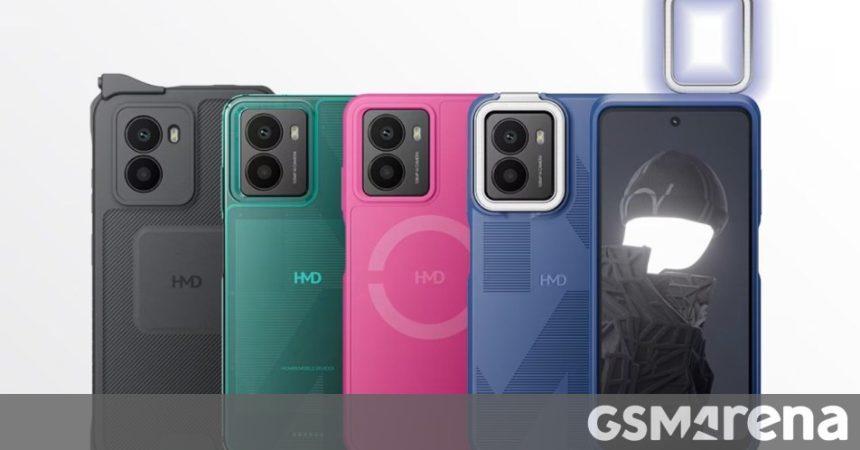
The idea was genuinely exciting: a phone you could reshape with clip-on hardware backs, from gaming grips to rugged cases with real electrical contacts. HMD gave us that dream with the original Fusion back in September of 2024, and last October a follow-up seemed all but certain when whispers of a Fusion 2 started circulating. Then… nothing.
Now a new report — from a source that’s usually reliable when it comes to HMD’s inner workings — suggests why the sequel never materialized. According to the rumor, HMD may have canceled the Fusion 2 project entirely, leaving the original Fusion as the company’s one and only modular handset.
To be clear, this isn’t official. The cancellation “hasn’t been confirmed yet,” so treat it as an educated guess rather than a done deal until HMD says otherwise. But if it does turn out to be true, the reasoning is depressingly familiar for anyone who follows ambitious hardware: high manufacturing costs and profitability issues.
And honestly? That tracks. Modularity is one of those concepts that sounds fantastic on a keynote slide and gets brutally expensive the moment you try to ship it. Every accessory back needs its own tooling, its own supply chain, its own inventory forecast. Contacts have to be reliable, connectors have to survive thousands of swaps, and the whole ecosystem only works if enough people actually buy into it. Google’s Project Ara, Motorola’s Moto Mods, LG’s ill-fated G5 — the graveyard of modular phones is already crowded, and each headstone reads roughly the same cause of death.
The original Fusion at least gave HMD a proof of concept. It positioned the company as one of the few willing to keep tinkering with the modular idea while the industry chased ever-thinner slabs and folding screens. A Fusion 2 would have been the crucial second step — the one that either builds a real platform or confirms the market just isn’t there.
If HMD has indeed pulled the plug, it’s a quiet admission that the numbers didn’t add up. That’s a shame for the enthusiasts who liked the notion of extending a phone’s usefulness with physical add-ons rather than replacing the whole device every couple of years. It’s also a reminder that clever engineering only survives if the accountants sign off on it.
For now, HMD hasn’t commented, and the Fusion 2’s fate rests entirely on unconfirmed chatter. We’d love to be proven wrong with a surprise announcement, but the smart money says the modular experiment has stalled — at least for this generation. If you were holding out for a next-gen Fusion, it might be time to look elsewhere.