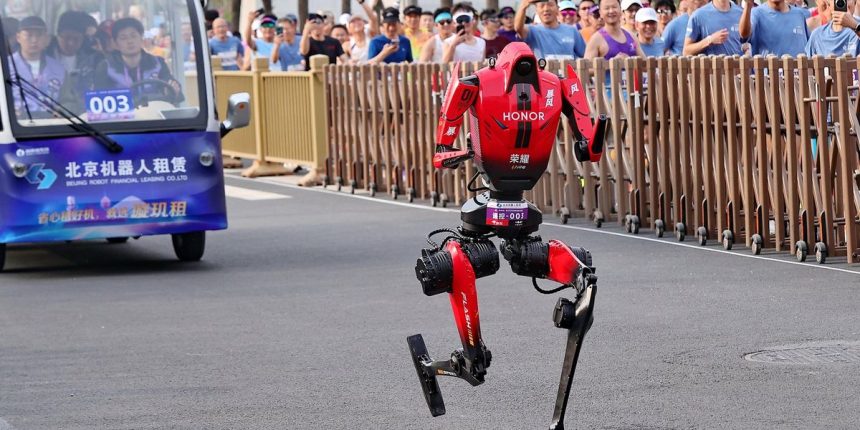
When the Honor Lightning humanoid clocked a half-marathon in 50 minutes and 26 seconds on April 19, 2026 at the Beijing E-Town Humanoid Robot Half-Marathon, the headlines fixated on one thing: it beat the human world record by seven minutes. That comparison is fun, but it misses the actual engineering story. Machines and humans have wildly different constraints — a robot running a course without GPS, without elbows jostling in a pack, is closer to Deep Blue beating Kasparov at chess than to a genuine athletic showdown. The interesting question is how Honor did it, and why better-known rivals like Unitree reportedly needed an ice backpack just to finish.
Start with the physics. Running alternates between a stance phase, where a leg pushes against the ground, and an aerial phase, where the body falls under gravity. Electric motors turn energy into torque, and the higher the torque, the more heat they dump. A geartrain amplifies torque but makes the rotor sluggish to accelerate — exactly what you don’t want when a leg needs to swing forward fast. Every motor therefore has a sweet spot for its gear ratio, and it depends heavily on the task.
Here’s the catch. A ratio tuned for running is far higher than one tuned for walking. A walking-optimized design (roughly 30:1) forced to run a half-marathon dumps over 300 W of heat into the knee motor — more than twice what a running-optimized design (around 45:1) produces. That’s the ice-pack territory rivals like Unitree and Agibot found themselves in. Honor simply built for the race: bigger leg motors, a running-friendly ratio, and around 400 W of total power consumption at the 7 m/s average pace.
Even done right, though, the knee motor still sheds roughly 150 W — an almost unavoidable consequence of running at human speeds with a humanoid-sized body. Ordinary air cooling can’t extract that continuously over 21 kilometers. Honor’s answer is the standout piece of engineering:
- Liquid-cooling pipes penetrate deep into the motors like capillaries
- A high-power pump moves coolant at more than 4 liters per minute
- Each of the four lower-limb drive motors gets its own independent cooling circuit
Liquid cooling isn’t new — it surfaces in research and Apptronik trialed it on prototypes — but it remains far from a commodity part. Without it, this pace would have been thermally unsustainable.
The Lightning stands 169 cm tall, packs 55 bionic joints, and its leg modules deliver up to 400 Nm of peak torque. Honor plans small-batch production in late 2026 and mass production in 2027, at roughly US$23,000.
The tradeoff is real, though. Those oversized running motors add weight, waste power when standing or walking, and risk bumping into things in a home or factory. The Lightning is a specialist, not an all-rounder. And that’s the deeper lesson: with AI closing the gap on so many technical tasks, the human skill of picking the right tradeoff is exactly what separates a good robot from a great one.