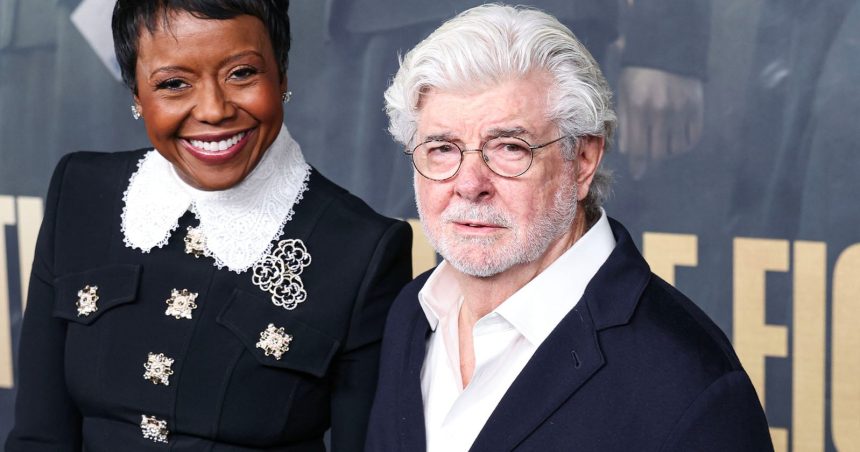
George Lucas has never been one to shy away from technological upheaval — he did, after all, build much of modern visual effects from scratch. So when the Star Wars creator weighs in on artificial intelligence, it carries the weight of someone who reshaped an entire industry once already.
Speaking to A Rabbit’s Foot, Lucas argued that AI ultimately makes filmmaking easier, and that resisting it is a losing battle. His analogy of choice? The automobile.
“It’s very much like sitting here saying, ‘Well, I believe the horse and the buggy is really where it’s at. These cars, they break down, they need gas, there’s all kinds of problems with them and pretty soon they’ll be making them into tanks, and then they’ll be killing people. It’s terrible.’ There’s nothing you can do about it,” Lucas said.
He framed AI plainly as “progress” and “the future.” And when pressed on the technology’s well-documented risks — deepfakes, misinformation, opaque provenance — Lucas offered a characteristically pragmatic take: the tools can police themselves.
“If you want AI that tells you when something is fake and where it came from, AI can do that,” he said. “Humans can’t, we’re not that smart. The whole idea is you’re a human being, you’re responsible for what you say and what you do, and if you’re doing something that’s illegal you should be punished for that. Whatever you do, you should be recognised. It’s just like real life.”
It’s worth remembering who’s talking here. Lucas founded Industrial Light & Magic in 1975 to conjure the special effects for Star Wars, and the studio’s early arsenal was resolutely hands-on: practical effects, motion control photography, miniatures and optical compositing. ILM would go on to become synonymous with the CGI revolution — a reminder that today’s cutting edge tends to become tomorrow’s baseline.
Lucas’s fascination with capturing motion predates all of that. Before he was a CGI pioneer, he worked as a cameraman on the 1966 film Grand Prix, a gig he landed off the back of his eight-minute student project 1:42.08 to Qualify. That dialogue-free piece followed racer Peter Brock trying to qualify in a Lotus 23 at Willow Springs Raceway, with Lucas riding alongside to capture gear changes and instrument panels. Its visceral, kinetic style still echoes through automotive cinematography.
He also has a track record of cashing out at the right moment — Lucas sold the Star Wars franchise to Disney in 2012 in a deal worth $4 billion.
He isn’t alone among big-name directors making peace with the technology, either. Martin Scorsese recently signed on as an adviser to AI image company Black Forest Labs. Whether you read that as inevitability or capitulation, the message from Hollywood’s old guard is increasingly consistent: the buggy days are over.