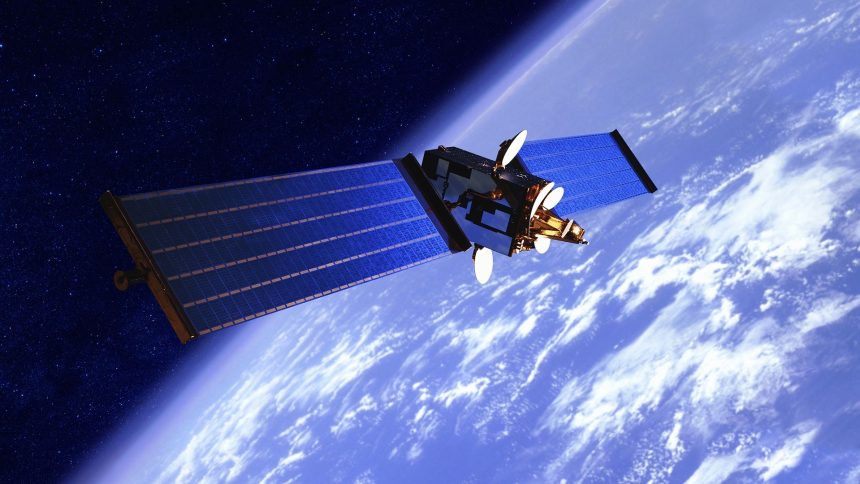
Forget the idea that only a handful of billionaires can string internet across the sky. Ukraine is now doing it too. A homegrown low-earth-orbit constellation called UASAT is taking shape, developed by Ukrainian company STETMAN, and it’s aiming to give the country its own answer to space-based broadband rather than leaning entirely on foreign networks.
The numbers are ambitious. The full constellation is planned to consist of 300 satellites, orbiting at an altitude of 550 km — the same crowded, fast-moving shell of low Earth orbit where most modern broadband constellations live. That altitude is chosen deliberately: fly lower and you shave off latency, which is exactly what you want if the network needs to carry real-time voice, video and command traffic without lag.
Coverage won’t stop at Ukraine’s borders. UASAT is designed to blanket Europe, North Africa and portions of the Middle East, giving it a genuinely regional footprint rather than a narrow national one. That’s a meaningful reach for a first-generation system, and it hints at a network built for resilience across a wide geography rather than a single service area.
The rollout is staged. The plan calls for 120 satellites in orbit by 2027, with the first satellite launch scheduled for October 2026 — the opening move in what’s meant to become a full working mesh. Getting from a single spacecraft to a constellation of hundreds is the hard part, but starting with a modest batch and scaling up is the standard playbook for LEO networks.
This is not a cheap undertaking. The total project cost is put at more than one billion euros, a figure that reflects just how capital-hungry satellite constellations really are. Between manufacturing hundreds of spacecraft, securing launch capacity and building the ground infrastructure to talk to them, the bill climbs quickly — and that’s before you factor in the years of operation ahead.
A few things are worth being clear about. UASAT is infrastructure, not a gadget you’ll be able to pre-order. It’s being developed for government, security and military use, so there’s no consumer terminal, no subscription tier and no shelf price attached. Think of it less as a product launch and more as a nation quietly assembling its own strategic communications backbone in orbit.
If STETMAN hits its milestones, the picture over the next couple of years is straightforward: one satellite up in October 2026, a growing cluster through 2027, and eventually a 300-strong constellation humming away at 550 km. It’s a bold bet on sovereign connectivity — and a reminder that the race to wire up low Earth orbit is no longer a two-horse contest.