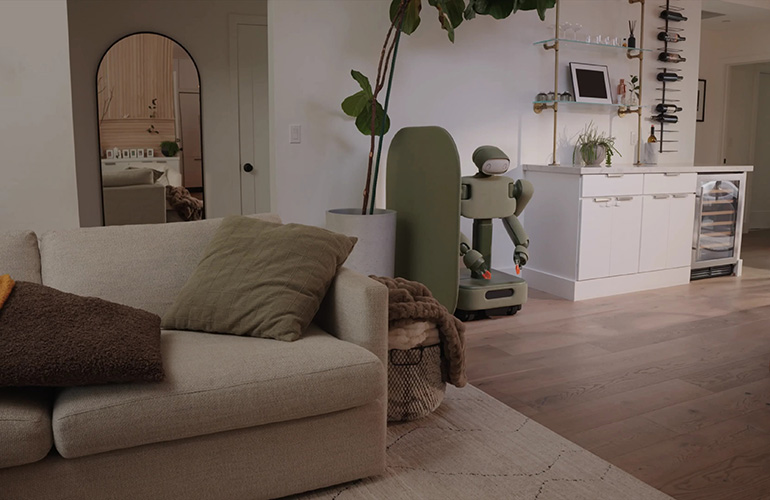
The dream of a robot that tidies up after you has been stuck in demo-reel purgatory for years. Weave Robotics wants to break that cycle with Isaac 1, its first mobile humanoid, which the company detailed at launch on July 1, 2026.
Isaac 1 skips the walking-on-two-legs theatrics that trip up so many humanoid prototypes and instead rides on a wheeled base. Above that base sit two arms, each tipped with a two-finger parallel gripper — a deliberately pragmatic setup aimed at real household work rather than viral parkour clips. It’s a bimanual manipulator built to be useful, not to impress a stage audience.
The clever bit is the adjustable torso. Isaac 1 can shrink to 3 ft. (0.9 m) to reach low shelves and floor-level clutter, then extend to a full 5 ft. 9 in. (1.7 m) to handle countertops, closets and higher storage. That vertical range is what turns a fixed-height arm on wheels into something that can actually cover the awkward geometry of a real home.
As for what it does, Weave is pitching Isaac 1 squarely at the tasks nobody enjoys. The robot can:
- make beds
- sort clutter
- fold clothes
- put items away
Those are exactly the fiddly, dexterity-heavy chores that have long humbled home robots, so seeing them on the official feature list — rather than vacuuming and not much else — is what makes Isaac 1 interesting. Whether the two-finger grippers can consistently fold a fitted sheet is the question every skeptic will be asking, and the one deliveries will answer.
Pricing lands at $7,999 outright, or $449 per month if you’d rather treat a household robot like a gym membership. Given the ambitions here, that’s aggressive positioning for a bimanual mobile manipulator, and the subscription route lowers the barrier to a home-robot experiment considerably.
Isaac 1 isn’t on sale yet. Customers can reserve a unit with a $250 deposit, with deliveries beginning in fall 2026 in California. Broader U.S. availability follows starting in 2027, so buyers outside the Golden State will need patience.
Weave is entering a suddenly crowded race to put a genuinely helpful humanoid inside people’s homes, and it’s betting that wheels, two arms and a stretchy torso beat legs and spectacle. If Isaac 1 delivers on its chore list this fall, the domestic-robot conversation gets a lot more concrete.