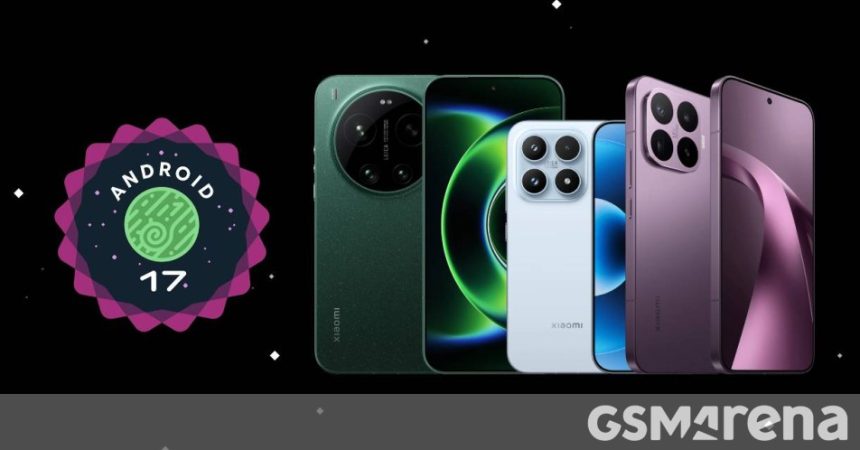
Xiaomi has become one of the first phone makers to push out stable Android 17, and it’s doing so quietly — almost too quietly. The rollout has reached the Xiaomi 17 and the Xiaomi 17 Ultra, with owners in the UK and US now able to grab the update over the air.
Here’s the confusing part: Xiaomi still calls this software HyperOS 3. That’s the exact same version name it used for the Android 16-based build, so there’s no obvious flag on the box telling you which Android release sits underneath. If you want to know whether you’re actually on Android 17, you’ll need to dig into the settings rather than trust the marketing label.
One reader in India reported firmware carrying the OS version 3.0.331.0.XPCINXM.C10 with a June 5 security patch — a reminder that the patch level isn’t quite as fresh as the headline Android number suggests. Rollouts like this tend to arrive in waves, so not every region or unit will see it at the same moment.
For context, Google’s Pixel line — going all the way back to the Pixel 6 — received stable Android 17 in mid-June. Many other manufacturers are still stuck in beta, which makes Xiaomi’s stable push notable, if understated.
The two phones getting the treatment are no slouches. The Xiaomi 17, announced in September 2025, packs a 6.31-inch AMOLED display at 1200×2656 resolution with peak brightness of 3500 cd/m², the Snapdragon 8 Elite Gen 5 chipset and a 6330 mAh battery. It starts at US$842.
The Xiaomi 17 Ultra, revealed in February 2026, goes bigger and bolder with a 6.90-inch AMOLED screen at 1200×2608, the same 3500 cd/m² peak brightness plus HDR10+, up to 16 GB of RAM and a hefty 1024 GB of storage. Its battery comes in at 6000 mAh, and it’s priced at £1,299 in the UK.
Worth noting: the Xiaomi 17T Pro, which arrived in May 2026 with its 6.83-inch AMOLED display at 1280×2772 and a 165Hz refresh rate (starting at US$678), is not part of this wave. It remains on Android 16 for now.
If you own a Xiaomi 17 or 17 Ultra, it’s worth checking for an update manually — just don’t be thrown when the version screen still reads HyperOS 3.