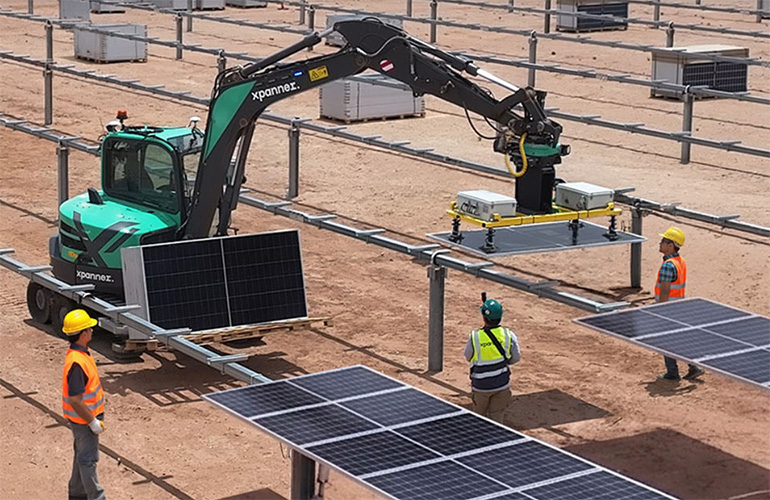
Building a utility-scale solar farm is grueling, repetitive work: crews spend hours hoisting, aligning, and bolting down thousands of heavy panels under a punishing sun. Xpanner wants to hand the backbreaking part of that job to a machine. On July 15, 2026, the company introduced the X1 Panel Lift, an automated system that turns an ordinary excavator into an intelligent panel-installation robot.
Rather than asking contractors to buy a bespoke, single-purpose vehicle, Xpanner built the X1 Panel Lift around hardware that solar crews already own and know how to operate. The system mounts onto existing excavators and folds the entire installation process into one workflow. The machine handles the heavy lifting and positioning, while the human team concentrates on the tasks that still demand a skilled eye and hand — precise alignment, fastening, and quality checks.
The clever bit is how the X1 Panel Lift perceives the world around it. A blend of LIDAR, vision, and GNSS sensors continuously builds a live 3D model of the worksite, so the system knows exactly where panels, rails, and obstacles sit at any given moment. That spatial awareness is what allows it to lift and drop panels into place with the kind of consistency that gets harder to maintain as a human crew tires over a long shift.
Running the show is Mango, Xpanner’s proprietary automation controller. Mango is responsible for the real-time decision-making that keeps the machine safe and accurate, coordinating precise control over the excavator’s hydraulic, electric, and mechanical systems. In practice, that means the platform can react on the fly rather than blindly repeating a preprogrammed motion — a necessity on uneven ground where no two panel placements are ever quite identical.
Xpanner is not selling the X1 Panel Lift as a piece of capital equipment. Instead, the company offers it through an all-inclusive subscription, a model that lowers the upfront barrier for contractors and bundles the automation package into an ongoing service rather than a one-time purchase. Xpanner has not disclosed the subscription price in its public announcements, and it has not confirmed a general sales or pre-order timeline.
The pitch lands squarely in one of the fastest-growing corners of the construction world. Solar deployment keeps accelerating, but skilled labor is scarce and the work is physically demanding — a combination that makes automation both appealing and, arguably, overdue. By leaning on excavators crews already have and layering intelligence on top, Xpanner is betting that the path to automated solar construction runs through augmentation rather than replacement.
It is a pragmatic vision: let the robot do the hoisting, and let the humans do the thinking. If the economics of that subscription add up, the X1 Panel Lift could become a familiar sight on solar sites.