Space robots have a power problem. You can’t run an extension cord to the International Space Station, and every gram you launch costs a fortune. That’s exactly the wall Icarus Robotics is trying to climb with JOY, its free-flying orbital robot — and the New York startup just settled the question of what keeps the lights on inside it.
On July 15, 2026, Icarus signed an agreement with KULR to power JOY using the KULR ONE Space (K1S) battery system. It’s a space-qualified pack built around a simple priority list: high energy density at the lowest possible mass. In orbit those aren’t marketing buzzwords — they’re the difference between a robot that can actually do useful work and one that spends its day tethered to a charging dock.
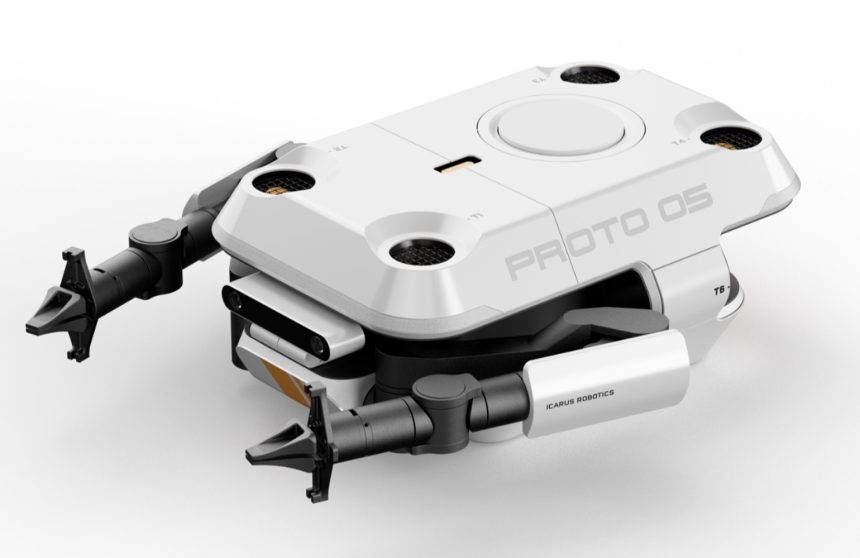
And JOY is designed to do real work. Rather than the tumbling cube-shaped drones we’ve seen float around the ISS before, JOY is fan-propelled and comes equipped with two 7-degrees-of-freedom (7DOF) arms. That arm configuration matters: seven joints per arm give it the kind of dexterity a human wrist and elbow take for granted, letting the robot reach around obstacles and orient its grippers freely in three dimensions.
The mission profile is deliberately practical. JOY is built to pick up and transport objects around a spacecraft — the kind of routine fetch-and-carry logistics that eat into astronaut time. Every minute a crew member spends hunting for a tool or ferrying equipment is a minute not spent on science, so offloading that grunt work to a capable robotic assistant is a genuinely useful proposition.
What makes JOY interesting from a hardware standpoint is how the pieces fit together:
- Propulsion: internal fans rather than reaction wheels or thrusters, keeping it safe inside a pressurized cabin
- Manipulation: a pair of 7DOF arms for genuine two-handed handling
- Power: KULR ONE Space battery systems running the onboard electronics
The battery choice is the linchpin. A fan-propelled robot with two active manipulators is thirsty, and doing all of that on a lightweight, space-rated pack is a tall order. By partnering with a supplier already producing space-qualified cells, Icarus sidesteps one of the hardest parts of building orbital hardware from scratch.
JOY isn’t a product you can buy — there’s no price tag, because this is a specialized platform bound for the ISS, not a shelf. Its debut is scheduled for the Joyride-1 mission in early 2027, at which point the robot will start proving whether a dexterous, free-flying assistant can earn its keep in orbit.
For now, the battery deal is the milestone: a small but crucial step that moves JOY from concept toward a station module near you — well, near the astronauts, anyway.